Speeches of the Hon. Jefferson Davis, of Mississippi; Delivered During the Summer
America's profound internal conflict still echoes, a period of division reshaping a nation and testing its ideals. To understand the arguments driving civil war, one must engage directly with voices at the storm's center. "Speeches of the Hon. Jefferson Davis, of Mississippi; Delivered During the Summer" offers this, presenting pronouncements of a man who became the Confederacy's central figure. This collection provides a window into antebellum Southern political thought and rhetorical strategies, inviting confrontation with fundamental questions of governance, liberty, and human rights from a fateful era. It remains a document of historical importance, a testament to rhetoric's power. Though a speech collection lacks traditional narrative, the "story" here is the compelling, tragic drama of national disintegration before the Civil War. The setting is mid-19th century American politics, particularly intense debates within the U.S. Senate and Southern public forums during the 1850s. The central figure, Jefferson Davis, emerges through his articulate addresses as a formidable advocate for Southern interests. He defends constitutional state rights and champions slavery. He appears not as an abstract figure, but as a man actively engaged in political struggles, using words to shape opinion and policy. The central conflict is the escalating sectional crisis pitting North against South. Davis's words chronicle his attempts to navigate this chasm, offering Southern perspectives on issues threatening the Union. Listeners hear his arguments on slavery's expansion, the balance of federal and state power, and Southern states' economic fabric. This collection's "arc" follows Davis's increasing frustration with perceived Northern aggression and his conviction that Southern states faced an existential threat. His addresses move from advocating compromise within the Union to defending secession as a legitimate response. The speeches capture a statesman's intellectual and emotional progression, building towards a political climax that altered the nation's course. Though this collection's compiler remains uncredited, the voice at its core belongs to Jefferson Davis, a figure inextricably linked with 19th-century America's seismic shifts. Born in Christian County, Kentucky, in 1808, Davis spent his formative years in Mississippi, the state he later represented. His early life included a distinguished military career, an education at West Point, and honorable service in the Mexican-American War. This background instilled duty, discipline, and strategy, qualities defining his political career. Davis's transition to influential politician began in the 1840s. He served as a U.S. Representative, then Senator for Mississippi. During Franklin Pierce's presidency, he was Secretary of War, demonstrating national leadership. He emerged as a leading voice for Southern interests, articulating a philosophy rooted in states' rights, strict constitutional interpretation, and slavery's defense as economically vital and constitutionally protected. His speeches represent this intellectual development, positioning him as an eloquent proponent of a distinct Southern identity within—or outside—the American Union. His words, though historical, were potent forces shaping a nation's discourse toward conflict. Central among Davis's themes is fierce advocacy for states' rights. He champions the idea that individual states, having voluntarily entered the Union, retained significant sovereignty and powers not explicitly delegated to the federal government. Federal intervention in matters like slavery or economic policy, to Davis, encroached upon these prerogatives. Listeners will hear him argue, for instance, that property rights—including enslaved persons—were inviolable and beyond federal reach in territories. This perspective is demonstrated in his responses to territorial legislation, arguing Congress lacked authority to prohibit slavery in newly acquired lands. He saw the Union's foundation resting on this balance, any imbalance threatening its integrity. Another prominent theme is the defense of Southern identity and honor, intertwined with the plantation system's economic realities. Davis frames Southern society as a distinct civilization, built on different principles and structures than the North's. His speeches often convey perceived slights from Northern politicians, met with staunch declarations of Southern dignity and self-determination. He links the South's prosperity and stability to slavery, presenting it not just as economic necessity but as a societal order to be defended. He might, for example, describe the Southern planter as a benevolent master, portraying the system as mutual obligation, contrasting sharply with emerging Northern abolitionist views. These speeches are crucial for understanding ideological justifications for defending the peculiar institution. This collection emerged from an America teetering on its greatest internal crisis. The 1850s saw profound political and social upheaval. Slavery, long a simmering tension, exploded with events like the Compromise of 1850, the Kansas-Nebraska Act, and the Dred Scott decision. These acts and rulings intensified the sectional divide, particularly concerning slavery's expansion into new western territories. Westward expansion fueled debates over popular sovereignty versus federal mandates, leading to conflicts like "Bleeding Kansas." Culturally, public oratory held immense power. Before mass media, speeches in legislative chambers or public squares were primary vehicles for shaping opinion and rallying support. Figures like Davis, Stephen A. Douglas, and Abraham Lincoln were giants of the spoken word, their addresses widely published. This was not merely policy; it defined the nation's soul. Davis's speeches reflect this environment, directly responding to escalating political pressures and articulating a coherent Southern position against what he viewed as a Northern assault. They are vital primary sources for understanding the intellectual landscape that led to secession and war. Experiencing these speeches as an audiobook offers an intimate connection with their historical moment. The several-hour run length allows for extended engagement—perfect for dedicated study or listening during commutes. Listeners appreciate the rhetorical flourishes, deliberate pacing, and persuasive cadences that would have held contemporary audiences spellbound. A skilled narrator brings Davis's voice to life, conveying the gravity, conviction, and strategic intent behind his words, moving beyond text to spoken argument. Pay close attention to how Davis constructs his points, the specific language he employs, and the atmosphere of intense political debate. Hearing these addresses helps humanize a controversial figure and allows for deeper understanding of the oratorical craft that shaped American history.
Enjoyed Speeches of the Hon. Jefferson Davis, of Mississippi; Delivered During the Summer? A few ways to support us
Audible & Amazon links are affiliate; we may earn a small commission at no extra cost.
About this production
Human narration by a volunteer reader from LibriVox.org, the public-domain audiobook project. LibriVox volunteers record literary works whose copyright has expired in the United States, releasing the resulting recordings into the public domain.
Speeches of the Hon. Jefferson Davis, of Mississippi; Delivered During the Summer by Jefferson Davis. The underlying text is in the U.S. public domain. We do not republish any modern copyrighted edition, translation, or commentary.
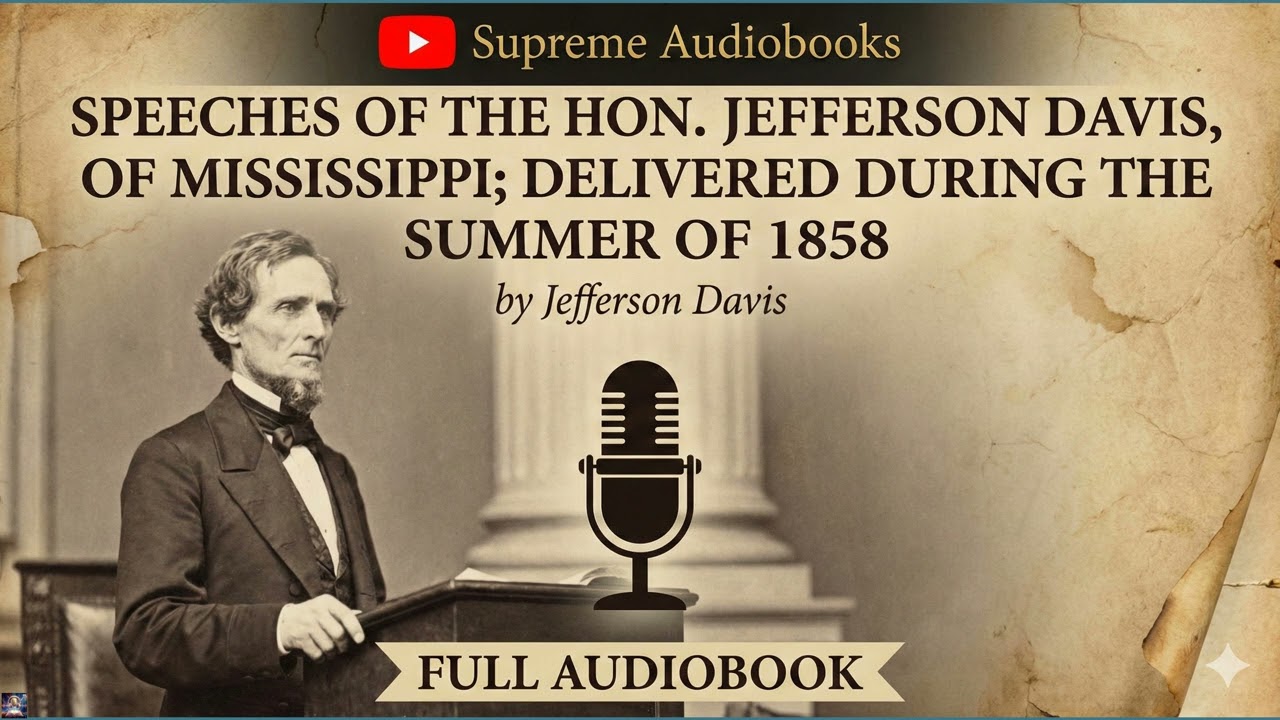
The 4K cinematic visuals accompanying this audiobook are generated by an AI image model from prompts derived from the source text. No copyrighted photos, paintings, or stock footage are used. AI generation is disclosed on every video on our YouTube channel as required by YouTube's altered/synthetic content policy.
English subtitles are transcribed from the LibriVox recording with OpenAI Whisper. Translations into the 11 other supported languages are produced by Meta's NLLB-200 neural translation model. No human translator's copyrighted translation is used.
Questions about sourcing or rights? See our DMCA & Sourcing policy or contact us.
Enjoyed this audiobook?
If you'd like to own a copy of Speeches of the Hon. Jefferson Davis, of Mississippi; Delivered During the Summer or hear a professionally produced edition, the links below help support free audiobook production at no extra cost to you.
As an Amazon Associate we earn from qualifying purchases. Audible / print links are affiliate.