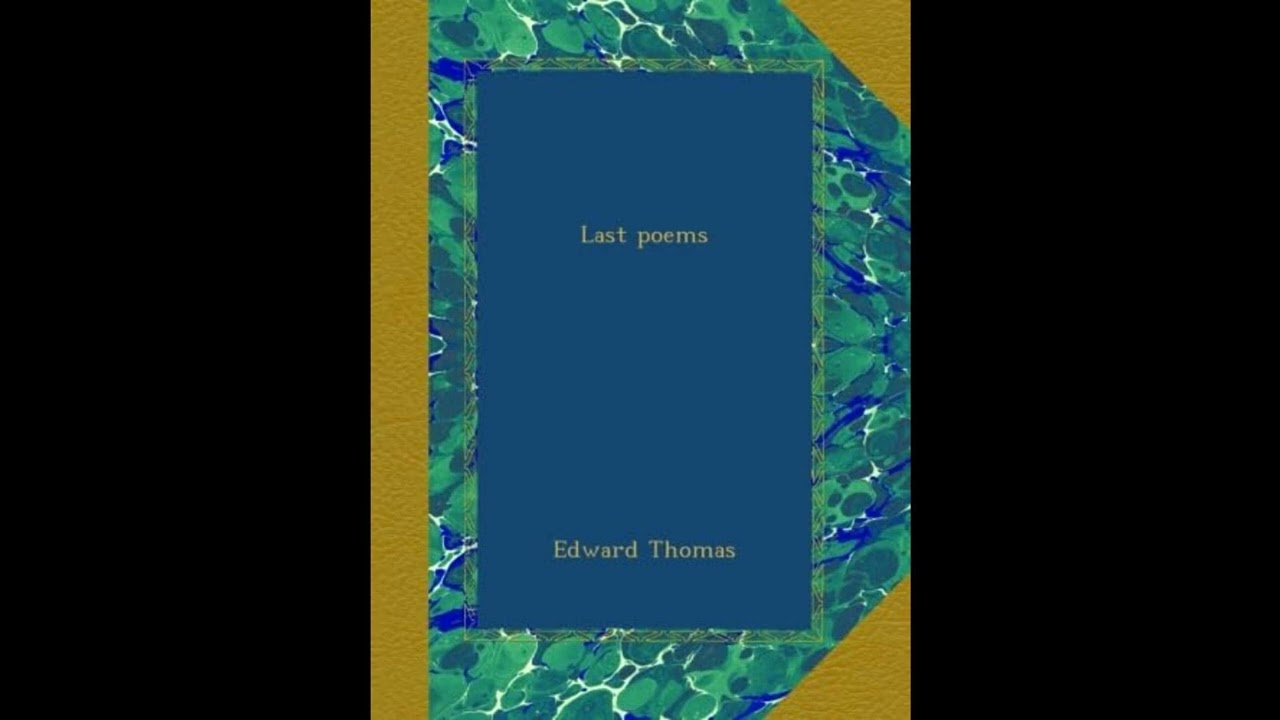
Last poems
Edward Thomas's Last Poems offers a profound and moving collection, a final literary statement from one of England's most quietly influential poets. This isn't a narrative in the conventional sense, but rather a journey through the contemplative landscape of a mind on the brink of profound change, grappling with the beauty of the everyday and the looming shadow of uncertainty. Listeners today find in Thomas's verse a voice that speaks to the enduring human experience of seeking meaning in nature, reflecting on memory, and confronting the fragility of peace – themes as resonant now as they were in the early twentieth century. It is an intimate encounter with a sensibility acutely attuned to the English countryside, yet universally applicable in its search for solace and understanding. The "story" within Last Poems unfolds not through characters or a structured plot, but through a sequence of meditations, observations, and deeply personal reflections. The setting is overwhelmingly the English countryside – the winding lanes, the ancient woods, the hedgerows, and the small, often unnoticed details of rural life. Thomas's poetic eye focuses on birds, trees, changing weather, and the transient beauty of seasons, particularly autumn and winter. The central figure is the speaker himself, often a solitary walker or observer, whose inner world is mirrored by the external landscape. He encounters fleeting presences – a countryman, a bird on a wire, the sound of a distant train – all of which trigger deeper thoughts about identity, home, and the passage of time. The overarching arc of the collection moves from a deep appreciation for the specific, tangible world to a growing sense of wistfulness and an unspoken, yet palpable, foreboding. There is a continuous struggle with the nature of belonging and the elusive quality of happiness, often just out of reach. Many poems wrestle with a sense of displacement, an inability to fully settle or understand one's true place. This internal conflict, sometimes expressed as a quiet melancholy, builds as the collection progresses, leading to a profound engagement with mortality and the stark realities of existence. Though the ending is not spoiled, the very title, Last Poems, imbues each verse with an extraordinary poignancy, knowing that these were some of the final words he would commit to paper. Edward Thomas himself led a life that, in many ways, mirrored the introspective nature of his later poetry. Born in Lambeth, South London, in 1878, to Welsh parents, he developed a deep affinity for the English countryside early on. For much of his adult life, he worked as a prolific literary critic, essayist, and biographer, producing works like The Life of Richard Jefferies and George Borrow: The Man and the Book. His output was substantial, but it was prose; he hadn't yet found his voice as a poet. This changed dramatically with his friendship with the American poet Robert Frost, who lived in England for a few years before the First World War. Frost recognized Thomas's poetic potential and encouraged him to transform his insightful prose observations into verse. This encouragement proved transformative. Thomas began writing poetry in late 1914, a concentrated burst of creativity that lasted only a few short years. His style was distinct from his Georgian contemporaries, favoring conversational rhythms, natural speech patterns, and a restrained emotional power. He chose to enlist in the Artists Rifles in 1915, despite being older than most recruits and a married father. Later commissioned into the Royal Garrison Artillery, he served on the Western Front. Tragically, Edward Thomas was killed at the Battle of Arras in April 1917, just as his poetic reputation was beginning to solidify. His work bridges the gap between the Romantic pastoral tradition and a nascent modernism, marking him as a singular voice. The poetry in Last Poems enacts several recurring themes with striking clarity. The relationship between nature and human emotion is central. In "Adlestrop," for instance, the speaker recalls a train stopping unexpectedly at a small station, a sudden quiet broken only by birdsong. This seemingly simple scene becomes a profound moment of connection, a sudden awareness of natural beauty interrupting the mundane. The natural world is not merely a backdrop but an active participant in the speaker's thoughts. Identity and the concept of home also figure prominently. "Lob" presents a composite, archetypal English countryman who is simultaneously everywhere and nowhere, a representation of enduring national character and the difficulty of pinning down a singular identity, reflecting Thomas's own sense of being an outsider-observer. Another powerful theme is memory and the weight of the past. Many poems are imbued with a nostalgic quality, a looking back at what was or what might have been. There is a sense of things fading, of the landscape holding untold stories, as seen in "The Owl," where the call of a lonely owl prompts a reflection on human suffering and a desire for personal peace amidst a world of pain. Finally, the imminence and impact of war, though rarely explicit, permeates much of the collection. Poems like "Rain" articulate a longing for solitude and a quiet, dignified end, a personal plea for peace in a world clearly hurtling towards chaos. This undercurrent of foreboding gives Last Poems an added layer of tragic depth, a prescient reflection on the end of an era. The period in which Edward Thomas wrote and published these poems was one of immense upheaval and transformation. The early twentieth century in Britain was a time of rapid social change, industrial expansion, and burgeoning international tensions, all of which culminated in the outbreak of the First World War. The Edwardian era's relative stability was giving way to widespread anxiety and uncertainty. Thomas's poems emerged from this crucible, capturing the quiet desperation and profound contemplation of an individual facing a world on the precipice. His focus on the unchanging aspects of the English landscape and the internal struggles of the individual can be seen as a retreat from, or a direct response to, the external forces threatening to shatter peace and tradition. He articulated a deeply felt connection to a disappearing way of life, speaking for a generation about to be irrevocably altered. Listening to Last Poems as an audiobook offers a unique and deeply enriching experience, especially given the conversational and often contemplative nature of Thomas's verse. The several hours of narration provide ample time to immerse oneself in his world, allowing the nuanced rhythms and subtle shifts in tone to fully register. A skilled narrator can bring out the quiet intensity, the natural cadences, and the precise imagery that are hallmarks of Thomas's style, highlighting the unrhymed, almost spoken quality of many pieces. The listener can attend to the carefully chosen words, the deliberate pauses, and the underlying emotional current that makes these poems so potent. The spoken word allows for a deeper appreciation of the work's musicality and its profound sense of atmosphere, transforming a solitary reading into a shared, intimate contemplation.
Enjoyed Last poems? A few ways to support us
Audible & Amazon links are affiliate; we may earn a small commission at no extra cost.
About this production
Human narration by a volunteer reader from LibriVox.org, the public-domain audiobook project. LibriVox volunteers record literary works whose copyright has expired in the United States, releasing the resulting recordings into the public domain.
Last poems by Edward Thomas. The underlying text is in the U.S. public domain. We do not republish any modern copyrighted edition, translation, or commentary.
The 4K cinematic visuals accompanying this audiobook are generated by an AI image model from prompts derived from the source text. No copyrighted photos, paintings, or stock footage are used. AI generation is disclosed on every video on our YouTube channel as required by YouTube's altered/synthetic content policy.
English subtitles are transcribed from the LibriVox recording with OpenAI Whisper. Translations into the 11 other supported languages are produced by Meta's NLLB-200 neural translation model. No human translator's copyrighted translation is used.
Questions about sourcing or rights? See our DMCA & Sourcing policy or contact us.
Enjoyed this audiobook?
If you'd like to own a copy of Last poems or hear a professionally produced edition, the links below help support free audiobook production at no extra cost to you.
As an Amazon Associate we earn from qualifying purchases. Audible / print links are affiliate.