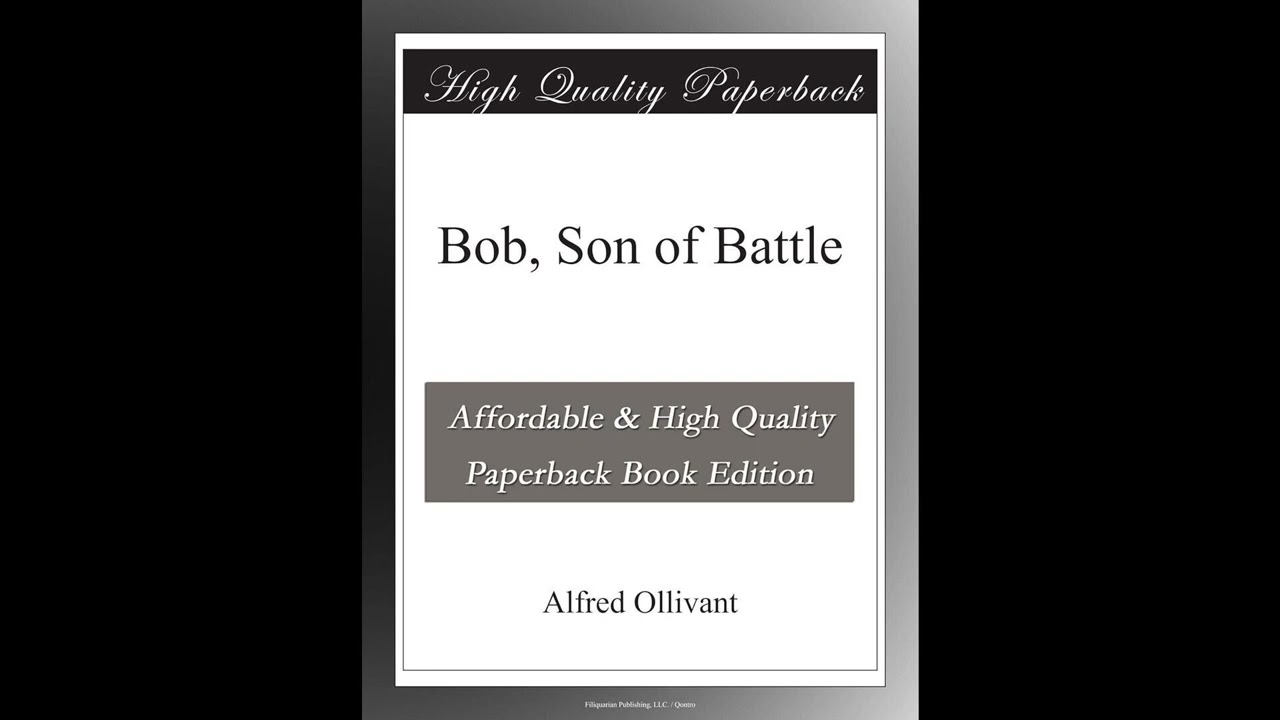
Bob, Son of Battle
"Bob, Son of Battle" is more than just a story about a dog; it is a resonant echo from a bygone era, a fierce and tender chronicle of loyalty, instinct, and the rugged beauty of life lived close to the land. Listeners today will find themselves drawn into a world where the bond between man and dog defines existence, where survival hinges on skill and courage, and where the stark, untamed landscape mirrors the raw emotions of its inhabitants. This classic tale, first published at the close of the nineteenth century, speaks to universal truths about competition, devotion, and the inherent drive within all creatures to prove their worth. The scene is set amidst the windswept fells and rolling moors of the Scottish Borders, a land where sheep farming is a way of life, steeped in tradition. Here, the annual sheepdog trials are the ultimate test, determining not only the best dog but also the reputation of its handler. At the heart of this world stands Adam McAdam, a formidable shepherd, whose life is inextricably linked to his prized Kye-dog, Owd Bob. Bob is a celebrated champion, an animal of almost legendary cunning and skill, revered for his ability to control his flock with uncanny precision. His prowess at the trials has earned him widespread renown and the grudging respect of his fellow shepherds. Yet, Bob's reign is not unchallenged. A dark shadow appears in the form of Red Wull, a powerful and fearsome Kye-dog owned by Tammas, a rival shepherd. Red Wull is everything Owd Bob is not – aggressive, wild, and unpredictable, a brute force compared to Bob's disciplined genius. Their rivalry is a deeply personal feud. The tension between the two dogs escalates with each encounter, culminating in a fierce competition that threatens the valley's fragile peace. The narrative builds towards the climactic annual sheepdog trials, where the ultimate champion will be crowned, and the true character of both dogs and men laid bare, without revealing the ultimate victor or the final twists. Alfred Ollivant, the author of "Bob, Son of Battle," was born in England in 1874. His education at Rugby School preceded a military career, during which he served in the Second Boer War (1899-1902) and the First World War. These experiences undoubtedly shaped his understanding of conflict, loyalty, and human endurance—themes that resonate deeply within his most famous work. Though "Bob, Son of Battle" (originally published as "Owd Bob" in the UK in 1898) remains his most celebrated book, Ollivant was a prolific writer. His other works, like "The Gentleman," set during the Napoleonic Wars, or "The Tides of War" (1915), demonstrate his consistent interest in human fortitude amidst great conflict. Ollivant's place in the literary canon is recognized for his significant contributions to animal fiction. His work falls within a tradition of authors who humanized animals, using their stories to reflect on human values. He possessed a profound ability to imbue his animal characters with personality and emotional depth, presenting them as intelligent beings with complex relationships and motivations. His work prefigured and influenced later writers who would similarly give voice and agency to animal protagonists, cementing his legacy as a compassionate and insightful chronicler of the natural world. At its core, "Bob, Son of Battle" presents a powerful examination of loyalty, a theme made manifest through Owd Bob's unyielding devotion to Adam McAdam. Despite the shepherd's stern demeanor, Bob's obedience and protective instincts towards his flock and master never waver, even when confronted by the aggressive tactics of Red Wull. This loyalty is not merely sentimental; it is a matter of survival, a fundamental aspect of the human-animal partnership necessary for life on the fells. The annual sheepdog trials, for instance, are not just about demonstrating skill, but about showcasing the deep trust and understanding built between dog and handler. Another prominent theme is the interplay between instinct and training, and what constitutes heroism. Owd Bob represents the pinnacle of disciplined training, his every movement a testament to years of careful guidance, yet his innate sheepdog instinct provides the foundation for his greatness. Red Wull, though powerful, often succumbs to his wilder, untamed impulses. The narrative raises questions about whether true greatness lies in raw power or the refined application of natural ability through rigorous discipline. Moments of unexpected heroism, often born from crisis—such as a sudden blizzard—demonstrate that courage emerges from necessity, proving valiant acts stem from both innate character and cultivated behavior. Alfred Ollivant published "Bob, Son of Battle" in 1898, placing it squarely in the late Victorian era, a period of immense social change. The Industrial Revolution had altered the urban landscape, leading to a nostalgic yearning for an idealized rural past. The book emerges from this sentiment, offering readers a window into the harsh life of the Scottish Borders. There was a burgeoning interest in nature writing and animal stories, partly as a response to Darwinian theories of evolution and partly as a form of sentimental escapism. Ollivant's work tapped into this cultural trend with a grittier realism, depicting farm life, the struggle for survival, and often-brutal competition. It also reflected a broader Victorian fascination with codes of honor and duty, translating into notions of inherited skill and disciplined performance. Listening to "Bob, Son of Battle" as an audiobook offers a unique opportunity to immerse oneself fully in its evocative world. The narrator's performance is crucial, bringing to life the distinctive regional accents of the shepherds, allowing their gruff wit and heartfelt declarations to truly resonate. You can almost hear the biting wind across the fells, the bleating of the sheep, and the tense silence before a crucial command, all conveyed through careful pacing and atmospheric delivery. Vocal shifts differentiate characters, giving distinct personalities to both the stoic Adam McAdam and the formidable Owd Bob himself. The several hours of listening allow for a gradual unfolding, making it ideal for commutes or quiet evenings, transporting you to the rugged heart of the Borders.
Enjoyed Bob, Son of Battle? A few ways to support us
Audible & Amazon links are affiliate; we may earn a small commission at no extra cost.
About this production
Human narration by a volunteer reader from LibriVox.org, the public-domain audiobook project. LibriVox volunteers record literary works whose copyright has expired in the United States, releasing the resulting recordings into the public domain.
Bob, Son of Battle by Alfred Ollivant. The underlying text is in the U.S. public domain. We do not republish any modern copyrighted edition, translation, or commentary.
The 4K cinematic visuals accompanying this audiobook are generated by an AI image model from prompts derived from the source text. No copyrighted photos, paintings, or stock footage are used. AI generation is disclosed on every video on our YouTube channel as required by YouTube's altered/synthetic content policy.
English subtitles are transcribed from the LibriVox recording with OpenAI Whisper. Translations into the 11 other supported languages are produced by Meta's NLLB-200 neural translation model. No human translator's copyrighted translation is used.
Questions about sourcing or rights? See our DMCA & Sourcing policy or contact us.
Enjoyed this audiobook?
If you'd like to own a copy of Bob, Son of Battle or hear a professionally produced edition, the links below help support free audiobook production at no extra cost to you.
As an Amazon Associate we earn from qualifying purchases. Audible / print links are affiliate.