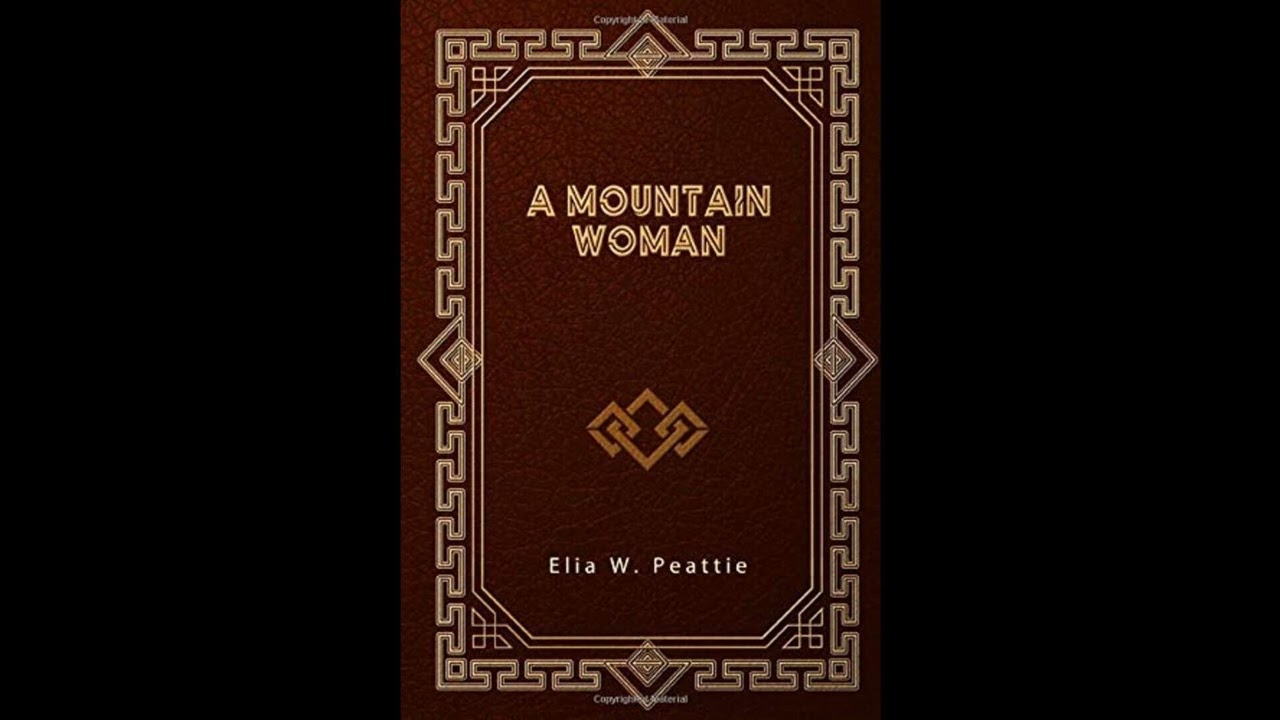
A Mountain Woman
Step into the stark beauty of the late 19th-century American West with Elia W. Peattie's "A Mountain Woman," a powerful and often overlooked novel that resonates deeply with contemporary questions of self-reliance and environmental connection. This compelling story offers a unique window into the inner life of a woman grappling with the immense challenges of independence, the raw power of nature, and the expectations of a burgeoning frontier society. Peattie's succinct, evocative prose creates an absorbing experience, bringing a specific historical moment to life while speaking to universal human experiences of belonging, resilience, and finding one's authentic place in the world. The narrative transports listeners to the rugged, unforgiving mountains of Colorado, a place of high altitudes, isolated cabins, and harsh weather. Here, we meet Isabel, a young woman transplanted from a more established, "civilized" background to this wild terrain. Her husband, perhaps less sensitive or more pragmatic, serves as a grounded counterpoint to her internal struggles. The story establishes her new life as a test—not just of physical endurance against the biting cold, constant danger, and profound loneliness, but of spirit. Isabel’s core conflict lies in her ability to adapt to this extreme existence; can she truly make a home in such a formidable landscape, or will the wilderness consume her sense of self? Peattie meticulously traces Isabel’s slow, often difficult transformation. The story follows her through a series of daily observations, small triumphs, and significant challenges that build her character. She learns the practicalities of mountain living—managing the cabin, preparing food, and enduring the elements. However, her true growth is spiritual and emotional, as she confronts the raw realities of her environment. The narrative carefully builds a portrait of a woman coming to terms with an unfamiliar landscape and the profound changes it demands of her, culminating in a deeper understanding of herself and her surroundings, without revealing the final outcome of her intensely personal quest. Elia Wilkinson Peattie, born in Kalamazoo, Michigan, in 1862, was a distinguished figure in American letters during the late 19th and early 20th centuries. Her career began in journalism, notably with the Chicago Tribune and later as literary editor for the Omaha World-Herald. This extensive background sharpened her keen observational skills and cultivated her precise, economical writing style. Her personal life, marked by a move to Nebraska and Wyoming with her husband, Robert Burns Peattie, profoundly shaped her fiction. The experience of living in the American West, far from established urban centers, directly inspired many of her stories, including "A Mountain Woman." She eventually returned to Chicago, where she continued her prolific output across various genres. Peattie authored numerous short stories, novels, and children's books. Her collections, like The Pictorial Review's Prize Stories (which included "The Doll") and novels such as The Judge, showcased her versatility and ability to capture diverse American experiences. While her name might not be as immediately recognizable today as some of her contemporaries, she was highly respected in her time. Critics praised her realistic portrayals of frontier life and her insightful character studies, particularly those of women navigating challenging circumstances. She holds an important place within American regionalism and realism, contributing significantly to the literary documentation of a rapidly changing nation and the complex lives within it. "A Mountain Woman" enacts several profound themes. One prominent idea is the assertion of independence and self-reliance, which Isabel embodies as she struggles to survive and thrive in her harsh environment. When left alone for extended periods, she must rely solely on her wits and strength to manage the cabin, procure necessities, and withstand the elements, directly challenging traditional notions of female dependence. Another central idea is the dynamic between nature and human endeavor. The stark contrast between Isabel's previous life and her existence in the wild mountains highlights this. Peattie often depicts Isabel's initial alienation from the unforgiving landscape—the biting cold, the vast silence, the ever-present danger—as a struggle against the "uncivilized" world. Yet, as the story progresses, she finds a peculiar strength and solace in nature, suggesting that true inner fortitude might reside within rather than against the wild. For example, a scene where she confronts a natural peril, like a sudden storm or an encroaching wild animal, forces her to discard genteel pretenses and embrace a more primal, capable self, leading to self-discovery and a quiet confidence. The book also subtly questions the prescribed roles for women in society. Isabel is not a delicate Victorian lady; she is a woman who learns to wield an axe, endure hardship, and confront isolation with a quiet fortitude. Her personal evolution in the face of such adversity offers a compelling early literary example of female agency, portraying a woman who adapts, suffers, and ultimately finds a distinct form of power in her own resilience, moving beyond the stereotypes prevalent in her era. "A Mountain Woman" appeared in 1896, a moment of profound transformation in the United States. The official closing of the American frontier was declared just a few years prior, yet the romanticized and often brutal realities of Western expansion continued to grip the national imagination. This era saw rapid industrialization, increasing urbanization, and significant social shifts, including burgeoning discussions about women's rights and their place outside the traditional domestic sphere. Literarily, this was the height of American realism and regionalism. Writers like Sarah Orne Jewett, Mary E. Wilkins Freeman, and Hamlin Garland were producing works that focused on specific locales and the everyday lives of ordinary people, often challenging romanticized ideals. Peattie's novel fits squarely into this tradition, offering an unvarnished, psychologically acute portrayal of a woman in a rugged Western setting, providing a nuanced counter-narrative to the more heroic, male-centric tales of the frontier. It reflects a growing interest in the interior lives of characters, particularly women, amidst changing landscapes, both physical and social. Listening to "A Mountain Woman" as an audiobook provides an immersive way to experience Peattie's quiet strength and lyrical descriptions. A skilled narrator can bring out the stark beauty of the Colorado landscape, lending appropriate gravity to the descriptions of isolation and the profound silence of the mountains. The pacing of the narration can echo the sometimes slow, deliberate rhythm of frontier life, allowing listeners to fully absorb Isabel's internal reflections and her gradual transformation. Listen for the subtle inflections that convey Isabel's hidden emotions—her fear, her determination, her growing sense of self—and the way dialogue, though sparse, reveals character and advances the nuanced human drama. The spoken word adds a layer of intimacy to Peattie's observant prose, making Isabel's story feel deeply personal and immediate, unfolding directly for the ear with every hour spent in her compelling world.
Enjoyed A Mountain Woman? A few ways to support us
Audible & Amazon links are affiliate; we may earn a small commission at no extra cost.
About this production
Human narration by a volunteer reader from LibriVox.org, the public-domain audiobook project. LibriVox volunteers record literary works whose copyright has expired in the United States, releasing the resulting recordings into the public domain.
A Mountain Woman by Elia W. Peattie. The underlying text is in the U.S. public domain. We do not republish any modern copyrighted edition, translation, or commentary.
The 4K cinematic visuals accompanying this audiobook are generated by an AI image model from prompts derived from the source text. No copyrighted photos, paintings, or stock footage are used. AI generation is disclosed on every video on our YouTube channel as required by YouTube's altered/synthetic content policy.
English subtitles are transcribed from the LibriVox recording with OpenAI Whisper. Translations into the 11 other supported languages are produced by Meta's NLLB-200 neural translation model. No human translator's copyrighted translation is used.
Questions about sourcing or rights? See our DMCA & Sourcing policy or contact us.
Enjoyed this audiobook?
If you'd like to own a copy of A Mountain Woman or hear a professionally produced edition, the links below help support free audiobook production at no extra cost to you.
As an Amazon Associate we earn from qualifying purchases. Audible / print links are affiliate.