The Great Gatsby
Few novels have so thoroughly permeated the American consciousness as F. Scott Fitzgerald's The Great Gatsby. Published in 1925, it stands as the definitive literary portrait of the Jazz Age, a dazzling and ultimately tragic examination of wealth, class, and the elusive pursuit of an idealized past. More than a century after its release, its insights into ambition, social illusion, and the American Dream's hollow promises remain acutely relevant. It speaks to our own era's fascination with success and the perpetual human yearning to recapture what has been lost, making it a story that resonates with profound and enduring power. The story unfolds during the summer of 1922, narrated by Nick Carraway, a young man from the Midwest who has come to New York to learn the bond business. He rents a small house in West Egg, a Long Island community characterized by its ostentatious "new money" mansions. Next door lives the enigmatic Jay Gatsby, a millionaire known for throwing lavish, bacchanalian parties every weekend, where guests from all walks of life mingle without ever truly knowing their host. Across the bay, in the more established "old money" enclave of East Egg, live Nick's cousin, Daisy Buchanan, and her powerful, arrogant husband, Tom Buchanan. As Nick becomes drawn into Gatsby's orbit, he learns of the millionaire's singular, all-consuming obsession: Daisy. Five years prior, before the war, Gatsby and Daisy shared a romance that was abruptly severed by circumstance and class differences. Now, Gatsby has amassed his fortune and built his grand estate with the sole purpose of winning Daisy back, believing that his newfound wealth can erase the past and recreate their love exactly as it once was. Nick finds himself reluctantly positioned as a bridge between the two, facilitating their reunion and witnessing the escalating tension as Gatsby's carefully constructed world collides with the entrenched realities of Daisy's life, her husband's brutal possessiveness, and the stark divide between their social standing. The narrative follows Gatsby's desperate attempts to rewrite history, leading to a series of fateful encounters and a climactic confrontation that lays bare the true costs of his grand delusion. F. Scott Fitzgerald, born in St. Paul, Minnesota, in 1896, lived a life that mirrored many of the themes in his fiction. A dashing figure with striking looks, he attended Princeton University, where he began writing, though he left before graduating to join the army during World War I. While stationed in Alabama, he met Zelda Sayre, a beautiful and spirited Southern belle who became his wife and muse. Their glamorous, tumultuous relationship became a symbol of the Jazz Age itself, characterized by extravagant spending, incessant parties, and a restless pursuit of pleasure. Fitzgerald's literary career exploded with the success of his first novel, This Side of Paradise, in 1920, which instantly made him a voice of his generation. He quickly followed with The Beautiful and Damned and a collection of short stories, cementing his reputation as the chronicler of the post-WWI era's disillusionment and moral ambiguity. He and Zelda spent significant time in Paris during the 1920s, becoming central figures in the "Lost Generation" expatriate community alongside writers like Ernest Hemingway. Though The Great Gatsby was not an immediate bestseller, Fitzgerald considered it his finest work. His later years were marked by financial struggles, Zelda's mental illness, and his own battle with alcoholism, which ultimately contributed to his untimely death in Hollywood in 1940, at the age of 44, while working as a screenwriter and on his unfinished novel, The Last Tycoon. Today, he is recognized as one of America's most important novelists, his prose admired for its lyrical beauty and his keen insights into the human condition. The Great Gatsby masterfully renders several profound themes through its narrative. One central idea is the American Dream and its corruption. Gatsby himself is a self-made man who pursues wealth not for its own sake, but as a means to achieve his ultimate goal: Daisy. His vast fortune, however, is built on shadowy dealings, suggesting that the pursuit of material success can lead to moral compromise. His grand mansion, his endless parties, his meticulously curated image – all of it is an elaborate performance designed to impress Daisy, yet it ultimately feels hollow, a gilded cage for a desperate hope. This shows the novel's critique of an American Dream that has become distorted by materialism and an emphasis on superficiality. Another significant theme is the power of the past and the futility of trying to recapture it. Gatsby lives in an eternal present, obsessively convinced that he can "repeat the past" with Daisy, ignoring the changes wrought by time and experience. His vision of Daisy is an idealized projection, one that exists more in his memory than in reality. Nick observes Gatsby's intense longing to fix things exactly as they were, a poignant yet ultimately doomed endeavor. The story also powerfully illustrates the rigid class structure of American society, contrasting the inherited privilege of "old money" embodied by Tom and Daisy Buchanan with Gatsby's newly acquired wealth. Despite his riches, Gatsby can never truly penetrate the exclusive world of the East Egg elite, whose disdain for his origins ultimately proves insurmountable. The novel emerged from a specific cultural moment: the Roaring Twenties. Following the devastation of World War I, America experienced an unprecedented economic boom and a period of profound social change. New technologies, mass consumerism, and relaxed moral codes characterized the decade. Women gained new freedoms, jazz music swept the nation, and prohibition led to an underground culture of speakeasies and organized crime. Fitzgerald brilliantly captures this era of excess and superficiality, where dazzling parties masked a deep-seated cynicism and disillusionment. The pursuit of pleasure often felt like a desperate attempt to forget the horrors of the war and the uncertainties of the future. In this context, The Great Gatsby reflects a re-evaluation of the American Dream. The traditional ideal of upward mobility through hard work and virtue was increasingly challenged by a more frantic, often morally ambiguous pursuit of wealth. Gatsby's questionable sources of income hint at the darker side of this new prosperity. The novel also showcases the cultural clash between the traditional values of the American heartland, represented by Nick, and the hedonistic, amoral lifestyle of the East Coast elite. It's a reflection of a nation grappling with its own identity, caught between lingering puritanical roots and a headlong rush into modernity. Listening to The Great Gatsby as an audiobook offers a unique opportunity to immerse oneself in Fitzgerald's exquisite prose. The narrator's voice becomes the lens through which Nick Carraway's observations are filtered, allowing the listener to fully appreciate the delicate nuances of his often-wry, sometimes wistful perspective. The five-hour, five-minute run time is perfectly suited for an attentive listen, perhaps over a few days or during a sustained period of quiet reflection. Pay close attention to how the narrator voices the distinct personalities: Gatsby's careful optimism and underlying vulnerability, Daisy's breathy, alluring yet ultimately shallow charm, and Tom Buchanan's aggressive arrogance. The atmosphere of both reckless abandon at Gatsby's parties and the quiet, desperate longing in his private moments are brought to life through skillful vocal performance, allowing Fitzgerald's poetic descriptions of the setting, the season, and the emotional landscape to truly settle into the imagination.
Enjoyed The Great Gatsby? A few ways to support us
Audible & Amazon links are affiliate; we may earn a small commission at no extra cost.
About this production
Human narration by a volunteer reader from LibriVox.org, the public-domain audiobook project. LibriVox volunteers record literary works whose copyright has expired in the United States, releasing the resulting recordings into the public domain.
The Great Gatsby, first published in 1925 by F. Scott Fitzgerald. The underlying text is in the U.S. public domain. We do not republish any modern copyrighted edition, translation, or commentary.
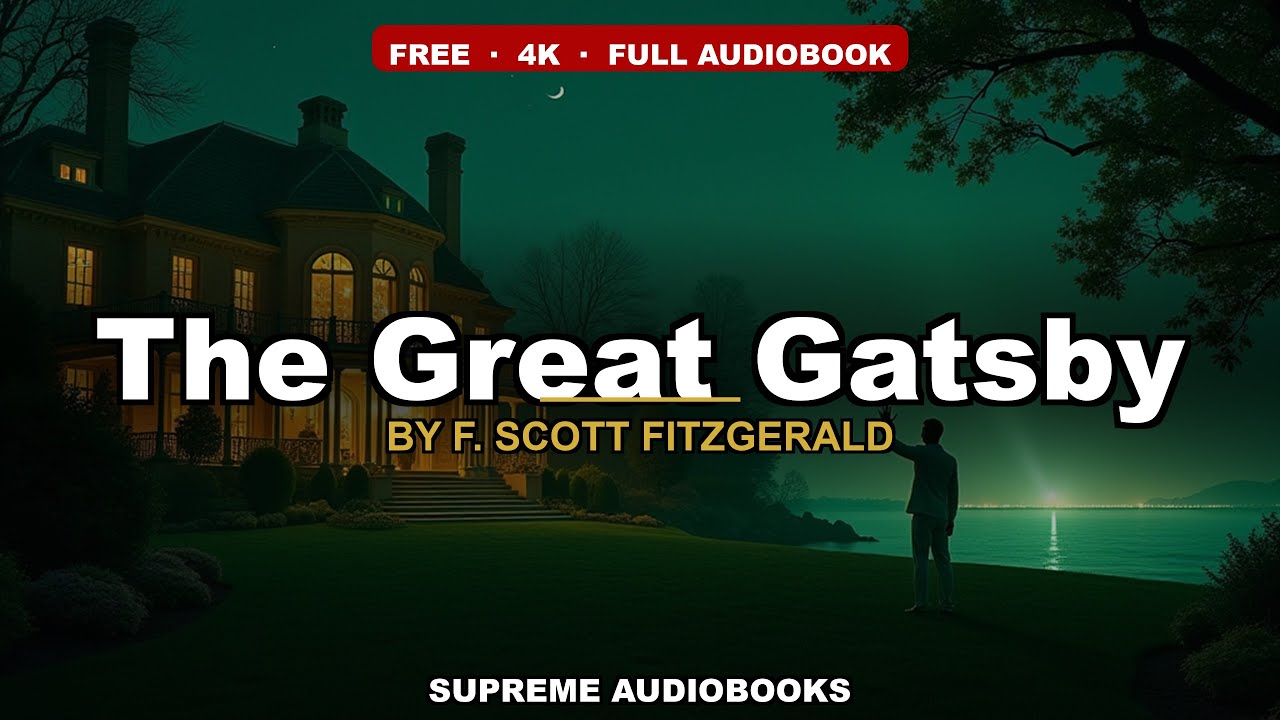
The 4K cinematic visuals accompanying this audiobook are generated by an AI image model from prompts derived from the source text. No copyrighted photos, paintings, or stock footage are used. AI generation is disclosed on every video on our YouTube channel as required by YouTube's altered/synthetic content policy.
English subtitles are transcribed from the LibriVox recording with OpenAI Whisper. Translations into the 11 other supported languages are produced by Meta's NLLB-200 neural translation model. No human translator's copyrighted translation is used.
Questions about sourcing or rights? See our DMCA & Sourcing policy or contact us.
Enjoyed this audiobook?
If you'd like to own a copy of The Great Gatsby or hear a professionally produced edition, the links below help support free audiobook production at no extra cost to you.
As an Amazon Associate we earn from qualifying purchases. Audible / print links are affiliate.