A Christmas Carol
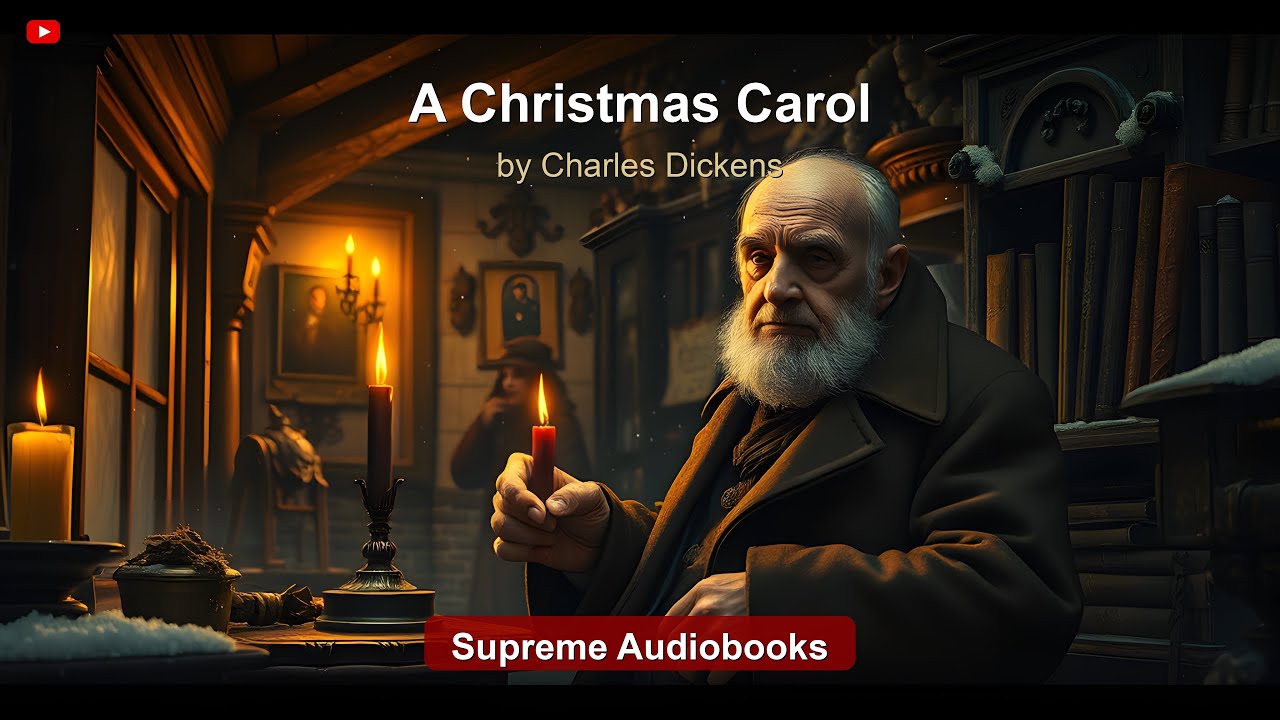
Few stories have burrowed so deeply into the collective consciousness, transcending mere narrative to become an indispensable part of our yearly celebrations, as Charles Dickens’s A Christmas Carol. More than a seasonal tale, it is a cultural touchstone, a universal parable of regret, redemption, and the enduring power of human connection. Listeners return to it not just for its festive setting, but for its profound message about empathy and the possibility of change, a message that feels as urgently relevant today as it did upon its initial publication in a bustling, often unforgiving Victorian London. It reminds us that the spirit of generosity is not confined to a single day, but a choice we make every moment. The story opens on a frigid, foggy Christmas Eve in London, where we meet Ebenezer Scrooge, a man as cold and sharp as the winter air itself. Scrooge is a solitary miser, a moneylender whose heart seems to have atrophied from disuse. He despises Christmas and everything it represents, viewing carols as a nuisance, charity as foolishness, and joy as an unnecessary expense. His only employee, the long-suffering Bob Cratchit, toils in a meager office, shivering beside a barely adequate fire, dreaming of Christmas dinner with his family while Scrooge grumbles about trivial costs. Scrooge dismisses his cheerful nephew Fred and two kindly gentlemen soliciting donations for the poor with a dismissive "Humbug!" – a phrase that has since become synonymous with his cynical outlook. That very night, an unsettling chain of events begins with the spectral visitation of Jacob Marley, Scrooge’s deceased business partner. Marley, bound by heavy chains forged from his own greed and indifference in life, appears as a chilling apparition, warning Scrooge of a similar, terrible fate should he continue his avaricious ways. Marley, his jaw unnaturally dropped, reveals that he is condemned to wander the earth, unable to intervene in human suffering despite his desire to do good. He offers Scrooge a chance at avoiding his own eternal torment, prophesying the arrival of three spirits who will visit Scrooge throughout the night, each bearing a lesson intended to wrench his hardened heart towards compassion. Charles Dickens himself was a product of the world he so vividly depicted, born in Portsmouth, England, in 1812. His early life was marked by hardship that would forever shape his literary sensibilities. When his father was imprisoned for debt in Marshalsea Debtors’ Prison, young Charles, still a boy, was forced to leave school and work ten-hour days in a blacking factory, pasting labels on pots of shoe polish. This traumatic experience of poverty and class injustice instilled in him a deep empathy for the working class and a fierce critique of social inequality, which would become central themes in his writing. Largely self-educated after his formal schooling ended prematurely, Dickens began his career as a parliamentary reporter and journalist before finding immense success as a novelist. His meteoric rise began with the publication of The Pickwick Papers in 1836, capturing the public’s imagination with his lively characters and social observations. Dickens went on to become arguably the most popular writer of the Victorian era, publishing a remarkable string of novels that captured the hearts and minds of millions. Works like Oliver Twist, which exposed the grim realities of workhouses and criminality, David Copperfield, drawing heavily on his own childhood experiences, and Great Expectations, a poignant story of class and identity, cemented his place as a literary giant. He perfected the art of the serialized novel, leaving readers eagerly awaiting the next installment, and his narratives often combined biting social criticism with memorable characters and a flair for dramatic storytelling. He died in 1870, leaving behind an unparalleled legacy. At its core, A Christmas Carol is a powerful exploration of themes that continue to resonate. Foremost among these is the stark contrast between avarice and generosity. Scrooge’s initial character is the embodiment of greed, his wealth hoarded rather than shared, his employees and community seen only through the lens of profit and loss. He dismisses charitable giving as a waste, suggesting the poor should simply die to "decrease the surplus population." This is sharply juxtaposed against the warmth and selflessness of characters like Bob Cratchit and his family, who, despite their poverty, find joy in their limited means and share what little they have. Another crucial theme is social responsibility. The narrative pointedly asks what duty the privileged owe to the less fortunate, illustrating through Tiny Tim’s vulnerability and the specters of Ignorance and Want, the dire consequences of societal neglect. Furthermore, the book offers a profound message of redemption and the transformative power of empathy. Scrooge’s internal struggle, spurred by the spirits’ revelations, demonstrates that even the most hardened heart can soften and change. The Ghost of Christmas Past shows him moments of youthful joy and lost love, revealing how he slowly chose money over affection. The Ghost of Christmas Present exposes him to the genuine happiness found in communal celebration, regardless of material wealth, particularly in the Cratchit household and his nephew’s festive gathering. And the terrifying visions shown by the Ghost of Christmas Yet to Come vividly illustrate the desolate future that awaits him if he refuses to alter his path. The story argues that true wealth lies not in financial accumulation, but in connection and kindness. When Dickens penned A Christmas Carol in 1843, England was in the throes of the Industrial Revolution. This period brought immense technological advancement and economic growth, but also severe social disparities. Rapid urbanization led to overcrowded cities, widespread poverty, and appalling working conditions for the lower classes. The controversial Poor Laws, which established workhouses and often separated families, were a stark reality. Dickens, who keenly observed these societal ills, used his fiction as a powerful platform for social commentary. Simultaneously, Christmas itself was undergoing a revival; while some ancient traditions persisted, new customs like the decorated Christmas tree (popularized by Queen Victoria’s German husband, Prince Albert) and the singing of carols were becoming more widespread, moving toward the festive, family-centric holiday we recognize today. This cultural backdrop provided fertile ground for A Christmas Carol. Dickens’s story tapped into both the burgeoning sentimentality for Christmas and a growing public awareness of social injustice. It offered a moral imperative for compassion at a time when industrial capitalism often seemed to dehumanize. The story's immediate success was immense, selling out its first edition in days. Its blend of supernatural elements with deeply human emotions, coupled with its clear moral message, made it an instant classic that profoundly influenced how Christmas was celebrated and perceived, promoting ideas of charity and goodwill that resonated deeply with its audience and sparked a renewed sense of philanthropy. Listening to A Christmas Carol as an audiobook brings an intimate quality to this foundational narrative. At a concise 3 hours and 23 minutes, it is perfectly suited for a single, immersive listening session, perhaps during a quiet evening or a thoughtful afternoon walk. A skilled narrator can truly elevate the experience, lending distinct, memorable voices to each character—from Scrooge’s gruff pronouncements to Tiny Tim’s gentle hope, from Marley’s rattling despair to the jovial warmth of the Ghost of Christmas Present. The spoken word allows the listener to fully absorb the atmospheric details of foggy London streets, the warmth of a hearth, and the chilling silence of a graveyard, drawing you into the emotional arc of Scrooge’s transformation with every nuanced inflection and carefully paced beat.
Enjoyed A Christmas Carol? A few ways to support us
Audible & Amazon links are affiliate; we may earn a small commission at no extra cost.
About this production
Human narration by a volunteer reader from LibriVox.org, the public-domain audiobook project. LibriVox volunteers record literary works whose copyright has expired in the United States, releasing the resulting recordings into the public domain.
A Christmas Carol, first published in 1843 by Charles Dickens. The underlying text is in the U.S. public domain. We do not republish any modern copyrighted edition, translation, or commentary.
The 4K cinematic visuals accompanying this audiobook are generated by an AI image model from prompts derived from the source text. No copyrighted photos, paintings, or stock footage are used. AI generation is disclosed on every video on our YouTube channel as required by YouTube's altered/synthetic content policy.
English subtitles are transcribed from the LibriVox recording with OpenAI Whisper. Translations into the 11 other supported languages are produced by Meta's NLLB-200 neural translation model. No human translator's copyrighted translation is used.
Questions about sourcing or rights? See our DMCA & Sourcing policy or contact us.
Enjoyed this audiobook?
If you'd like to own a copy of A Christmas Carol or hear a professionally produced edition, the links below help support free audiobook production at no extra cost to you.
As an Amazon Associate we earn from qualifying purchases. Audible / print links are affiliate.