Hamlet
From the haunted battlements of Elsinore to the deepest recesses of the human mind, William Shakespeare’s Hamlet stands as an enduring monument to grief, betrayal, and the agonizing quest for justice. First performed around the turn of the 17th century, this tragedy is not merely a story of a Danish prince seeking revenge; it is a profound and unsettling inquiry into the nature of existence itself. Listeners today still grapple with Hamlet’s paralyzing introspection, his moral quandaries, and the devastating consequences of indecision, finding in his ancient struggle a mirror to their own anxieties about purpose, morality, and the search for meaning in a chaotic world. It asks us to confront the darkness within ourselves and the systems that shape us, making it as urgent and relevant now as it was four centuries ago. The story unfolds in the somber court of Denmark, where young Prince Hamlet is still shrouded in mourning for his recently deceased father, King Hamlet. His sorrow is compounded by the shockingly swift marriage of his mother, Queen Gertrude, to his uncle, Claudius, who has now ascended the throne. This hasty union fills Hamlet with disgust and suspicion, a sense of foreboding that soon manifests in a chilling encounter. On a cold, moonlit night, Hamlet is confronted by the ghost of his father, who reveals a horrifying truth: he was not taken by natural causes, but brutally murdered by Claudius, who poured poison into his ear while he slept. The ghost demands revenge, burdening Hamlet with a terrifying and almost impossible task. Stunned and heartbroken, Hamlet adopts an "antic disposition"—a facade of madness—to mask his true intentions and buy time to uncover proof of Claudius's treachery. His erratic behavior pushes away those closest to him, including the gentle Ophelia, daughter of the King's chief counselor, Polonius, who struggles to understand the sudden shift in his demeanor. Hamlet orchestrates a play within a play, titled "The Mousetrap," designed to mirror the circumstances of his father's murder, hoping to gauge Claudius's reaction and confirm his guilt. The king’s visibly disturbed response during the performance confirms Hamlet’s worst fears, setting a collision course that will lead to a series of escalating confrontations and profound personal tragedies, as Hamlet grapples with the moral weight of his vengeance and the terrible price of action. The author of this towering drama was William Shakespeare, a name synonymous with literary genius. Born in Stratford-upon-Avon, England, in 1564, he received a relatively modest education before moving to London, where he established himself as an actor and playwright. By the 1590s, he was a prominent member of the Lord Chamberlain's Men, a theatrical company that would later become the King's Men under the patronage of King James I. His prolific output spanned comedies, histories, and tragedies, forever changing the landscape of English literature. Shakespeare's other renowned plays include the tender romance of Romeo and Juliet, the fantastical whimsy of A Midsummer Night's Dream, the tyrannical ambition of Macbeth, and the heartbreaking descent into madness of King Lear. Beyond his stage works, he penned a collection of lyrical sonnets that stand as some of the finest poems in the English language. He retired to his hometown around 1613 and passed away in 1616, leaving behind a legacy that has resonated across centuries, shaping language, theatre, and the way we understand the human spirit. His works are cornerstones of the English literary tradition, widely studied, performed, and adapted around the globe. Hamlet is a crucible of profound human experience, exploring several themes that continue to resonate. One central idea is the crushing weight of grief and the difficulty of authentic mourning. Hamlet’s melancholy is palpable from the outset, contrasting sharply with the superficial cheer of the court. His famous lament, "O, that this too too solid flesh would melt," encapsulates his profound despair and longing for oblivion, a deep-seated sorrow exacerbated by his mother's hasty remarriage. This intense personal suffering grounds the abstract philosophical questions he later poses. Another vital theme is the distinction between appearance and reality, and the madness that results when they blur. Hamlet feigns insanity, putting on an "antic disposition" to mislead his enemies, but the line between his acted madness and genuine psychological distress becomes increasingly thin, particularly as the pressures mount and the body count rises around him. Ophelia’s tragic descent into real madness offers a stark counterpoint to Hamlet's calculated performance, showing the devastating consequences when the mind breaks under unbearable strain. Furthermore, Hamlet meticulously examines the ethics of revenge versus justice, a dilemma that paralyzes its protagonist. The ghost of King Hamlet demands vengeance, but the prince struggles with the moral implications of such an act, agonizing over whether to commit murder himself or trust in a higher, divine justice. His iconic "To be, or not to be" soliloquy is not just about life and death, but also about action and inaction, the fear of the unknown, and the courage required to confront fate. This deep introspection and moral hesitance set Hamlet apart from typical revenge tragedy heroes, transforming the play into a complex psychological study rather than a straightforward tale of retribution. The play’s lasting power lies in its unflinching portrayal of human fallibility, the corrupting nature of power, and the often-futile search for truth in a world rife with deception. The early 17th century, when Hamlet was penned, marked a fascinating and turbulent period in English history. Queen Elizabeth I's long and stable reign was drawing to a close, leading to anxieties about succession and political stability. The transition to King James I brought its own set of challenges, including questions of divine right, court intrigue, and the ongoing religious tensions following the Reformation. Culturally, it was the zenith of English Renaissance drama, with public playhouses like the Globe drawing audiences from all walks of life. Playwrights were increasingly exploring complex psychological depths and moral ambiguities, moving beyond earlier, more simplistic dramatic forms. Shakespeare was certainly influenced by earlier revenge tragedies, particularly those of Seneca, but he imbued Hamlet with an unprecedented degree of philosophical inquiry and psychological realism. The play emerged from a time when individual conscience and reason were becoming increasingly important, even as societal structures remained hierarchical. Hamlet's relentless questioning of authority, both political and moral, his internal struggle with faith and doubt, and his intensely personal grief resonated deeply with an audience grappling with changing worldviews. It was a time of intellectual ferment, where the individual’s place in the cosmos was under scrutiny, and Hamlet perfectly encapsulated that profound shift. Listening to Hamlet as an audiobook offers a singular experience, allowing the sheer poetry of Shakespeare's language to wash over you. The 3-hour and 46-minute run length is substantial enough to feel fully immersed, yet manageable for repeated listening or taking in over a few focused sessions, perhaps during a long drive or a quiet evening at home. A skilled narrator brings a vital layer of interpretation to the dense prose, illuminating the nuances of character and emotion that can sometimes be missed on the page. You can truly hear the subtle shifts in Hamlet’s voice, from his weary despair to his biting sarcasm, from his philosophical musings to his moments of desperate fury. The pacing of the dialogue, the pregnant pauses, and the atmospheric sounds of Elsinore Castle—whether implied or subtly rendered—create a vivid theatrical world within your mind, allowing the tragedy’s dramatic tension and profound insights to unfold with compelling immediacy.
Enjoyed Hamlet? A few ways to support us
Audible & Amazon links are affiliate; we may earn a small commission at no extra cost.
About this production
Human narration by a volunteer reader from LibriVox.org, the public-domain audiobook project. LibriVox volunteers record literary works whose copyright has expired in the United States, releasing the resulting recordings into the public domain.
Hamlet, first published in 1603 by William Shakespeare. The underlying text is in the U.S. public domain. We do not republish any modern copyrighted edition, translation, or commentary.
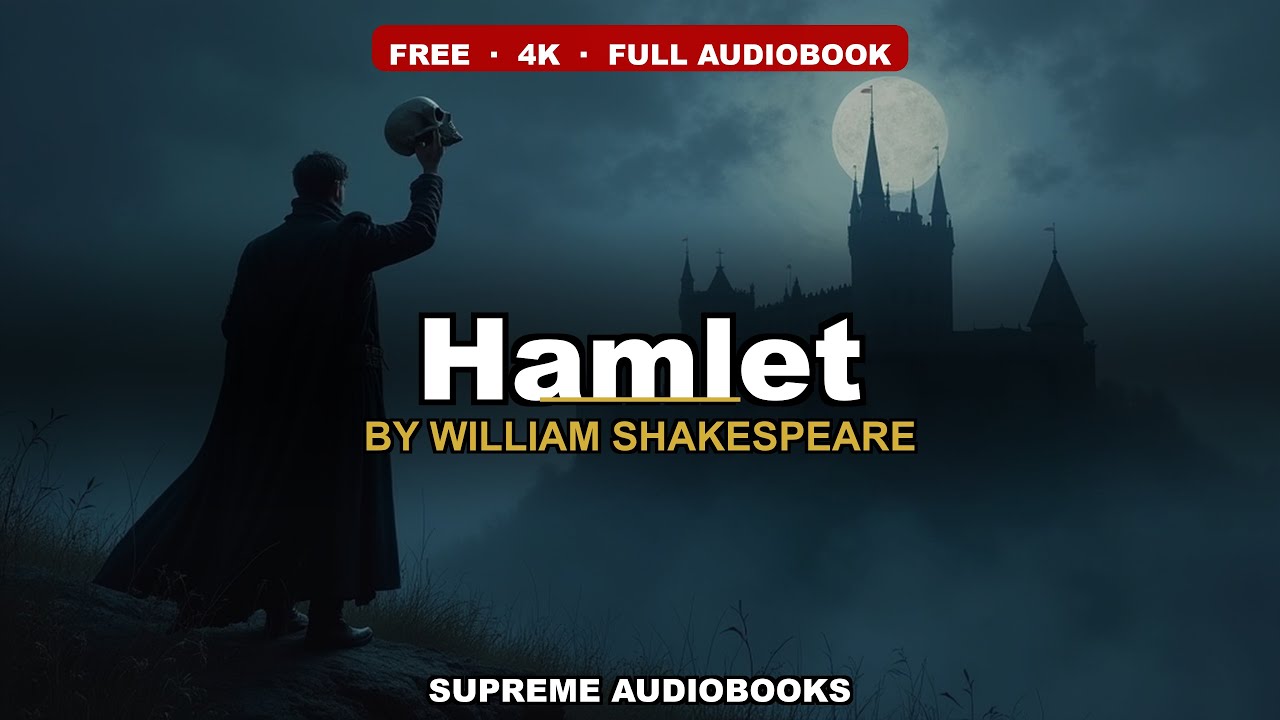
The 4K cinematic visuals accompanying this audiobook are generated by an AI image model from prompts derived from the source text. No copyrighted photos, paintings, or stock footage are used. AI generation is disclosed on every video on our YouTube channel as required by YouTube's altered/synthetic content policy.
English subtitles are transcribed from the LibriVox recording with OpenAI Whisper. Translations into the 11 other supported languages are produced by Meta's NLLB-200 neural translation model. No human translator's copyrighted translation is used.
Questions about sourcing or rights? See our DMCA & Sourcing policy or contact us.
Enjoyed this audiobook?
If you'd like to own a copy of Hamlet or hear a professionally produced edition, the links below help support free audiobook production at no extra cost to you.
As an Amazon Associate we earn from qualifying purchases. Audible / print links are affiliate.