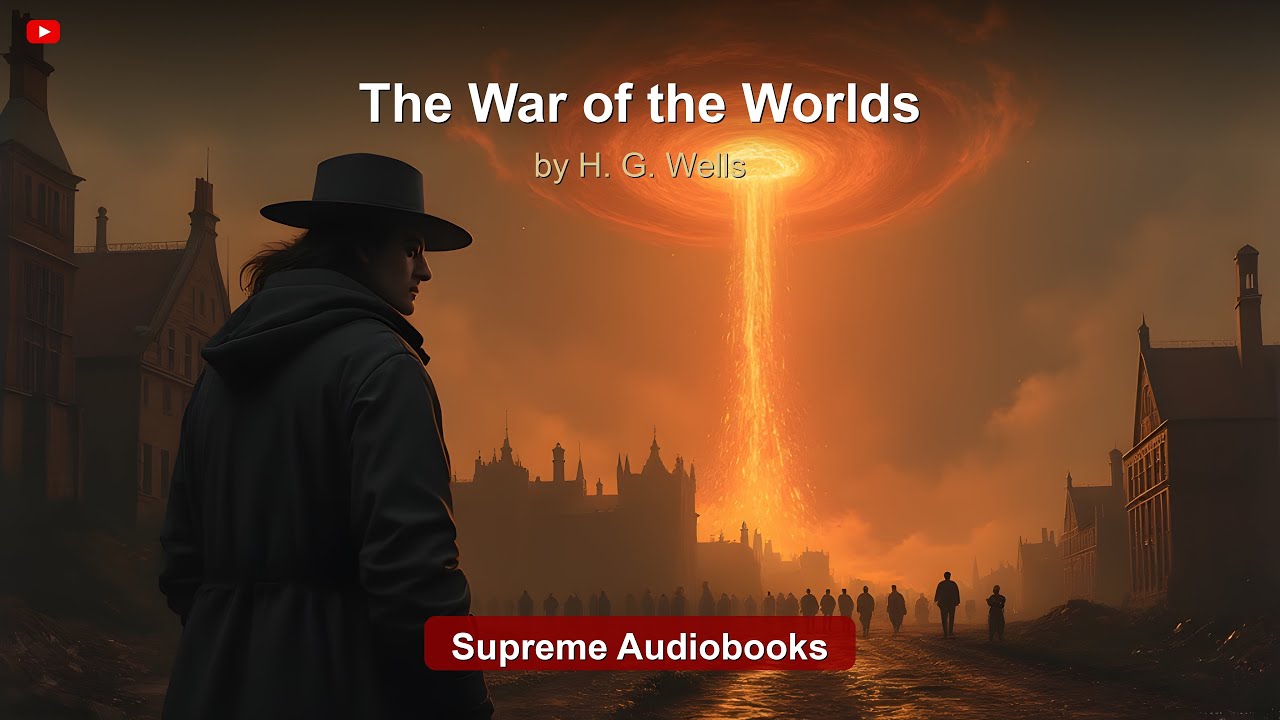
The War of the Worlds
Imagine a world where the very sky turns ominous, where humanity's supposed dominion over the Earth is shattered in an instant by a threat beyond all imagining. H. G. Wells’s The War of the Worlds, first published in 1898, remains the quintessential alien invasion narrative, a foundational text that not only birthed a genre but also forever changed how we perceive our place in the cosmos. More than a century after its initial appearance, this story resonates with profound relevance, speaking to our anxieties about technological advancement, environmental vulnerability, and the eternal question of what lies beyond our reach. It forces us to confront our own arrogance and consider the stark reality that we might not be alone—and that any encounter could be catastrophic. The story opens in the tranquil suburbs of late 19th-century England, specifically in the county of Surrey, a landscape of polite society and scientific curiosity. Our unnamed narrator, a philosophical writer, observes strange occurrences on Mars—a luminous gas, then a meteor-like projectile crashing near his home in Woking. What begins as a local curiosity quickly transforms into unadulterated terror when the "meteor" reveals itself to be a cylinder, disgorging monstrous Martian creatures. These beings, grotesque and alien, begin their systematic conquest of Earth, equipped with devastating technology that far surpasses anything humanity possesses. The primary weapon of the Martians is the Heat-Ray, a silent, invisible beam of pure energy that vaporizes everything in its path, coupled with their colossal, three-legged fighting machines, the Tripods, which stride across the landscape like mechanical titans. Panic erupts as the Martians advance, sweeping aside military resistance with ease. The narrator is separated from his wife in the ensuing chaos, forced to flee for his life amidst a stampede of humanity, witnessing firsthand the complete breakdown of civilization. His desperate struggle for survival takes him through deserted, burning towns, across devastated countrysides, and into harrowing encounters with other refugees, each struggling with their own fear and moral compromises, as he desperately tries to reunite with his loved one in a world irrevocably altered. H. G. Wells, born Herbert George Wells in Bromley, Kent, in 1866, was a visionary author whose influence on science fiction and social commentary is difficult to overstate. From humble beginnings as an apprentice draper, Wells pursued an education in biology under the renowned T. H. Huxley, an experience that profoundly shaped his scientific imagination and his critical perspective on society. He transitioned from teaching to a prolific writing career, crafting some of the most enduring works of speculative fiction. Wells was not only a pioneer of science fiction but also a keen social critic and a member of the Fabian Society, advocating for social reform. His ability to blend scientific speculation with astute observations about human nature and societal structures defined his unique literary voice. Beyond the terrifying vision of The War of the Worlds, his other notable contributions include The Time Machine, an exploration of class division and evolutionary decay; The Island of Doctor Moreau, a chilling tale of scientific hubris and vivisection; and The Invisible Man, a psychological study of power and corruption. Wells's predictions of future technologies and societal changes—from tanks and atomic bombs to global conflict and even space travel—underscore his remarkable foresight and cemented his place as a literary giant. He passed away in 1946, leaving behind a legacy that continues to inspire and provoke thought. The War of the Worlds enacts several profound themes that resonate even today. Perhaps most starkly, it serves as a powerful commentary on imperialism and colonialism. Wells brilliantly reverses the roles, casting humanity as the "primitive" inhabitants facing a technologically superior invading force. The Martians treat Earth's inhabitants with the same ruthless disregard and dehumanization that European colonial powers often displayed toward indigenous populations, viewing them merely as resources or obstacles. The chilling efficiency with which the Martians harvest blood for sustenance, for example, mirrors the exploitation of conquered peoples and lands, offering a stark, unflattering reflection of Victorian-era attitudes. Another central theme is human hubris and vulnerability. At the peak of the British Empire, Victorian society largely considered itself the zenith of civilization, safe and invulnerable. The Martian invasion brutally shatters this illusion, demonstrating the fragility of human institutions, technology, and even life itself when confronted with an truly alien force. The initial complacency and even scientific curiosity of the characters quickly give way to absolute terror and utter helplessness, as the world's most powerful armies prove utterly useless against the alien Tripods and their Heat-Rays. The novel vividly illustrates how easily our sophisticated systems can collapse, revealing the raw, desperate struggle for survival beneath the veneer of civilization. When The War of the Worlds was published in 1898, Britain stood at the height of its imperial power, confident in its global dominance and technological superiority. This was a period of intense industrial advancement and scientific discovery, fostering a pervasive sense of optimism about human progress, but also underlying anxieties about the social and ethical implications of these changes. Wells, ever the astute observer, tapped into both the era’s fascination with scientific possibility and its simmering fears of invasion, particularly from competing European powers. The novel also reflects the prevailing social Darwinist ideas of the time, albeit through a critical lens. Wells turns the concept on its head, positing a superior species from another planet applying the brutal logic of "survival of the fittest" to humanity itself. By forcing his readers to experience invasion from the perspective of the invaded, Wells offered a chilling allegory for Britain’s own colonial practices and a subtle warning about the unforeseen consequences of unchecked power and aggression, suggesting that even the mightiest empire could be brought to its knees. Listening to The War of the Worlds as an audiobook offers an intensely immersive experience, bringing the visceral terror and escalating dread of Wells’s narrative to life. At 6 hours and 26 minutes, it’s a perfectly paced production, ideal for long commutes, a weekend afternoon, or a series of evening walks. A skilled narrator can amplify the mounting panic and the stark desperation of the protagonist, lending particular weight to Wells’s precise, often chilling descriptions of the Martian advance and humanity’s chaotic flight. Pay attention to the shifts in tone, from the narrator’s initial detached scientific curiosity to his subsequent profound fear and despair, which a strong vocal performance can highlight. The soundscape of an audio rendition—the imagined thrum of the Heat-Ray, the ponderous clank of the Tripods, the cries of a world in disarray—can deepen the atmosphere, transforming a quiet read into a truly unforgettable auditory ordeal.
Enjoyed The War of the Worlds? A few ways to support us
Audible & Amazon links are affiliate; we may earn a small commission at no extra cost.
About this production
Human narration by a volunteer reader from LibriVox.org, the public-domain audiobook project. LibriVox volunteers record literary works whose copyright has expired in the United States, releasing the resulting recordings into the public domain.
The War of the Worlds, first published in 1898 by H. G. Wells. The underlying text is in the U.S. public domain. We do not republish any modern copyrighted edition, translation, or commentary.
The 4K cinematic visuals accompanying this audiobook are generated by an AI image model from prompts derived from the source text. No copyrighted photos, paintings, or stock footage are used. AI generation is disclosed on every video on our YouTube channel as required by YouTube's altered/synthetic content policy.
English subtitles are transcribed from the LibriVox recording with OpenAI Whisper. Translations into the 11 other supported languages are produced by Meta's NLLB-200 neural translation model. No human translator's copyrighted translation is used.
Questions about sourcing or rights? See our DMCA & Sourcing policy or contact us.
Enjoyed this audiobook?
If you'd like to own a copy of The War of the Worlds or hear a professionally produced edition, the links below help support free audiobook production at no extra cost to you.
As an Amazon Associate we earn from qualifying purchases. Audible / print links are affiliate.