Steppenwolf
What if the parts of yourself you found most unbearable, most monstrous, were precisely the keys to your salvation? Hermann Hesse's Steppenwolf, published in 1927, plunges into the tormented psyche of Harry Haller, a man adrift in a world he no longer understands, a figure whose acute sense of alienation and profound spiritual malaise resonates as powerfully today as it did nearly a century ago. This novel is a searing examination of identity, an unflinching look at the clash between instinct and intellect, and a provocative invitation to embrace the messy, contradictory totality of human experience. It speaks to anyone who has ever felt like an outsider, an anomaly struggling to reconcile their inner wilderness with the demands of conventional society. The story opens with Harry Haller, a middle-aged intellectual and writer, recounting his struggles in a meticulously kept manuscript. He presents himself as the "Steppenwolf," a solitary, misanthropic creature—half man, half wolf—caught between his refined, spiritual intellect and his wild, untamed animalistic instincts. Living in a quiet, respectable German city, Harry is deeply repulsed by the shallow conformity and bourgeois values he sees around him, particularly in his temporary lodgings with a prim landlady and her nephew. His days are a melancholic cycle of solitary walks, profound introspection, and contemplating suicide as the only escape from his existential despair. He feels himself perpetually at odds with the modern world, a relic of a more profound era, and his deep-seated misery is almost a source of pride, reinforcing his self-imposed isolation. A chance encounter, a mysterious advertising sign for a "Magic Theater - For Madmen Only," begins to pull Harry out of his self-constructed prison. Drawn by an inexplicable force, he stumbles into a lively, unconventional dance hall where he meets Hermine, a charismatic and enigmatic young woman who sees through Harry's intellectual posturing and challenges his self-pity. Hermine, with her uncanny insight and playful cruelty, becomes his guide into a different kind of existence, introducing him to the sensual pleasures he has long denied himself. Through her, Harry encounters Maria, a beautiful courtesan who awakens his capacity for love and desire, and Pablo, a free-spirited musician and drug dealer who offers a different path to understanding himself. These encounters force Harry to confront the very aspects of life he has intellectualized away, pushing him toward a profound, if sometimes terrifying, process of self-reckoning that culminates in the surreal landscape of the Magic Theater. Hermann Hesse, born in 1877 in Calw, Germany, lived a life marked by restless introspection and a search for spiritual truth, elements that would profoundly shape his literary output. The son of Pietist missionaries, he rebelled against conventional education, even attempting suicide in his youth, before finding his calling in writing. His early career included work as a bookseller and clock factory mechanic, formative experiences that fueled his observations of human nature. Hesse’s pacifist stance during the First World War led to public condemnation in Germany, yet he remained steadfast in his convictions. Later, personal crises—including marital difficulties, the death of his father, and his son's severe illness—drove him to seek psychoanalytic therapy with a student of Carl Jung, a period of self-analysis that deeply influenced his subsequent novels, including Steppenwolf. His literary legacy is vast, encompassing a body of work that consistently grapples with themes of individualism, the search for authenticity, and the spiritual quest. Prior to Steppenwolf, Hesse had already gained recognition for novels like Demian, a coming-of-age story influenced by Jungian thought, and Siddhartha, a philosophical novel about the spiritual journey of a young man during the time of the Buddha. He would later write Narcissus and Goldmund and his magnum opus, The Glass Bead Game (Magister Ludi), for which he was awarded the Nobel Prize in Literature in 1946. Hesse's unique blend of German Romanticism, Eastern philosophy, and psychoanalytic depth firmly established him as a canonical figure, one whose works found a particularly fervent following among counterculture movements in the mid-20th century. Steppenwolf enacts several profound themes. Central to the novel is the theme of alienation and the outsider status, exemplified by Harry Haller's profound disconnect from the "bourgeois" world around him. His detailed self-analysis in his manuscript reveals his intellectual disdain for conventional life, his preference for solitude, and his feeling of being fundamentally different, a "wolf" among sheep. His observations of the landlady's nephew and the petty squabbles he overhears reinforce his belief in his own superiority, even as he despairs over his isolation. Another powerful theme is the duality of human nature, symbolized by Harry's "man-wolf" metaphor. The novel vividly portrays his internal struggle between his intellectual, spiritual, and artistic aspirations and his primitive, instinctual drives. He yearns for high culture and philosophical discourse, yet finds himself drawn to the taverns and the sensual experiences that Hermine and Pablo offer, a constant push and pull between two seemingly irreconcilable parts of himself. The novel also foregrounds the theme of self-discovery and individuation, as Harry is forced, often painfully, to confront his own limitations and expand his narrow worldview. Hermine's role is crucial here; she does not allow him to wallow in his self-pity, instead challenging his intellectual arrogance and forcing him to engage with life on a more visceral level—through dance, through sensuality, through simple human connection. This process is further intensified by his interactions with Maria and Pablo, who each open new dimensions of experience for him, revealing that true self-acceptance lies not in denying one's instincts but in integrating them. Finally, Steppenwolf functions as a potent critique of bourgeois society. Hesse uses Harry's perspective to expose the spiritual emptiness, suffocating conformity, and superficiality he perceived in post-World War I European culture. Harry's internal monologues often target the hypocrisy and banality of mainstream life, reflecting a broader societal disillusionment with established values and institutions. Published in 1927, Steppenwolf emerged from a period of profound cultural and political upheaval in Europe following the First World War. Germany, under the Weimar Republic, was grappling with the aftermath of devastating conflict, economic instability, and a questioning of traditional morality. This era saw the rise of new artistic movements—Expressionism, Dadaism—that reflected widespread disillusionment and a search for new forms of expression. Sigmund Freud's psychoanalytic theories were gaining traction, prompting a greater public awareness of the complexities of the human psyche. Hesse, having personally experienced the trauma of the war, the loss of his family home, and his own psychological struggles, channeled this collective malaise into Harry Haller's story. The novel became a profound artistic response to a "lost generation" trying to find meaning in a world that seemed to have lost its way, a deeply personal and societal crisis reflected in Harry's internal landscape. Listening to Steppenwolf as an audiobook offers a singular opportunity to immerse oneself in Harry Haller's intensely introspective world. The narrator's voice becomes crucial in conveying the nuances of Harry's profound despair, his dry wit, and the intellectual rigor of his internal monologues. Over its seven-hour runtime, the story unfolds with a deliberate, reflective pacing, allowing listeners to fully absorb the philosophical debates and the vivid, often surreal, descriptions of Harry's consciousness. A skilled performance can bring to life the distinct personalities of Hermine's confident pragmatism, Pablo's enigmatic wisdom, and Maria's gentle sensuality, enriching the contrast with Harry's initially rigid worldview. Listen for the shifting moods, from melancholic solitude to the vibrant, almost hallucinatory atmosphere of the Magic Theater, allowing the spoken word to guide you through this transformative and thought-provoking experience.
Enjoyed Steppenwolf? A few ways to support us
Audible & Amazon links are affiliate; we may earn a small commission at no extra cost.
About this production
Human narration by a volunteer reader from LibriVox.org, the public-domain audiobook project. LibriVox volunteers record literary works whose copyright has expired in the United States, releasing the resulting recordings into the public domain.
Steppenwolf, first published in 1927 by Hermann Hesse. The underlying text is in the U.S. public domain. We do not republish any modern copyrighted edition, translation, or commentary.
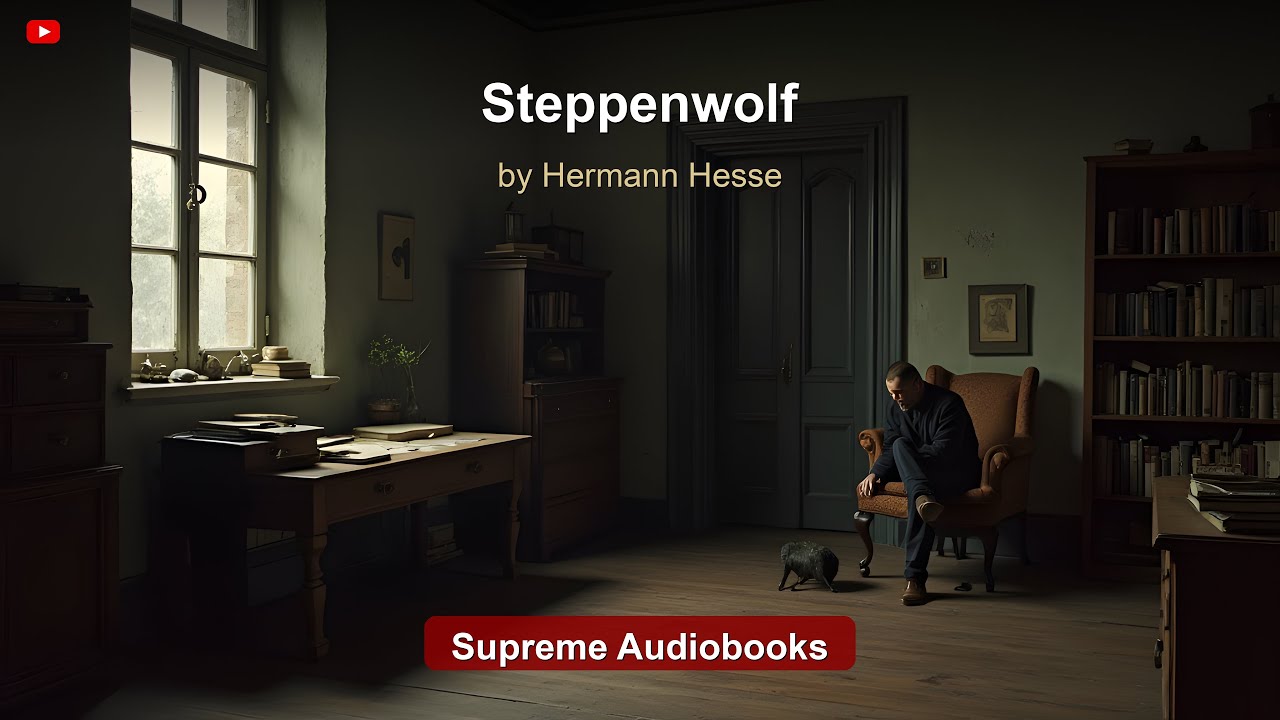
The 4K cinematic visuals accompanying this audiobook are generated by an AI image model from prompts derived from the source text. No copyrighted photos, paintings, or stock footage are used. AI generation is disclosed on every video on our YouTube channel as required by YouTube's altered/synthetic content policy.
English subtitles are transcribed from the LibriVox recording with OpenAI Whisper. Translations into the 11 other supported languages are produced by Meta's NLLB-200 neural translation model. No human translator's copyrighted translation is used.
Questions about sourcing or rights? See our DMCA & Sourcing policy or contact us.
Enjoyed this audiobook?
If you'd like to own a copy of Steppenwolf or hear a professionally produced edition, the links below help support free audiobook production at no extra cost to you.
As an Amazon Associate we earn from qualifying purchases. Audible / print links are affiliate.