The Wonderful Wizard of Oz
For over a century, a little girl from Kansas and her peculiar companions have invited readers into a world of sparkling shoes, talking animals, and emerald cities. The Wonderful Wizard of Oz, first published in 1900, remains a foundational text in American literature and a beloved cornerstone of children's fantasy. Its vivid imagery, memorable characters, and surprisingly potent themes continue to resonate today, offering more than just a whimsical escape but also a nuanced look at courage, friendship, and the very idea of home. This is a story that has transcended its pages to become a cultural touchstone, shaping generations of storytellers and dreamers, and its unique blend of the ordinary and the magical holds just as much power for contemporary listeners as it did for its first readers. The narrative begins on the dusty, grey plains of Kansas, where young Dorothy Gale lives with her Aunt Em, Uncle Henry, and her little dog, Toto. Their life is hard, marked by the relentless sun and the monochrome landscape. One fateful day, a powerful cyclone sweeps across the prairie, lifting Dorothy’s small farmhouse – with her still inside – and carrying it far away from everything she knows. It lands with a thump in the magical land of Oz, specifically in the Country of the Munchkins, inadvertently crushing the Wicked Witch of the East. Dorothy is greeted as a heroine by the tiny Munchkins and the kind Good Witch of the North, who gives her the dead witch’s silver shoes and instructs her to seek help from the all-powerful Wizard of Oz in the distant Emerald City if she wishes to return to Kansas. Thus begins Dorothy’s extraordinary peregrination down the Yellow Brick Road. Along the way, she encounters a Scarecrow who longs for a brain, a Tin Woodman who desperately desires a heart, and a Cowardly Lion who dreams of true courage. Each has heard of the Wizard’s immense power and hopes he can grant their deepest wishes. Together, this unlikely quartet faces a series of challenges, from mischievous winged monkeys to treacherous poppy fields, their bond strengthening with every obstacle overcome. Their ultimate goal is the magnificent Emerald City, where the mysterious Wizard promises to fulfill their individual desires, though his true nature and the path back to Kansas remain elusive and fraught with peril. The visionary behind this enduring tale was Lyman Frank Baum, born in Chittenango, New York, in 1856. His early life was a varied and often challenging series of ventures. Before finding his true calling as a writer, Baum tried his hand at several careers, including poultry breeding, managing a theatrical company, and even owning a general store in South Dakota, where he also edited a newspaper. These diverse experiences, from the grit of the American frontier to the theatrical world, undoubtedly fueled his imagination and provided a rich backdrop for his later storytelling. Baum’s personal life was also marked by his connection to significant figures; he married Maud Gage, daughter of the prominent suffragist Matilda Joslyn Gage, whose progressive ideals may have influenced Baum’s own thinking about strong female characters. It wasn't until his early forties that Baum began to focus seriously on writing for children. His earlier works, like Mother Goose in Prose and Father Goose: His Book, hinted at the whimsical style that would define his later career. In 1900, The Wonderful Wizard of Oz was published, marking a turning point not just for Baum but for American children’s literature. He explicitly stated his intention to create a new kind of "wonder story," one free from the grim moralizing of many European fairy tales and instead filled with joy and excitement. Baum went on to write thirteen more Oz books before his death in 1919 in Hollywood, California, establishing a literary world that would continue to expand long after his passing, cementing his legacy as the "Royal Historian of Oz" and a pioneer of American fantasy. At its core, The Wonderful Wizard of Oz is a story about the search for self and the realization of inner strength. The Scarecrow, the Tin Woodman, and the Cowardly Lion each believe they lack essential qualities—a brain, a heart, courage—and expect the Wizard to magically bestow them. Yet, throughout their adventures, the Scarecrow consistently demonstrates cleverness and ingenuity in navigating their path, the Tin Woodman shows profound compassion and empathy for others, and the Cowardly Lion repeatedly faces down danger, protecting his friends despite his proclaimed fear. Their physical quests are, in fact, metaphors for discovering the virtues they already possess, a potent reminder that true power often lies within. This idea ties closely into another central theme: the nature of home. Dorothy’s unwavering desire to return to Kansas, despite the fantastical wonders of Oz, underscores that home is not merely a place but a feeling of belonging and familiarity. Even in the extraordinary Emerald City, she remains grounded by her longing for her plain, grey farm, suggesting that true contentment comes from within oneself and the simple comforts of one’s origins, rather than from external glamour or magic. The story also cleverly plays with the concepts of illusion versus reality, particularly in the representations of the Wizard himself and the splendid Emerald City, hinting that appearances can be deceiving and that perceived power may hide humble truths. Published at the turn of the 20th century, The Wonderful Wizard of Oz emerged during a period of significant change in America. The country was experiencing rapid industrialization, urbanization, and a burgeoning sense of national identity distinct from its European roots. This was also an era when the Populist movement was gaining traction, reflecting economic anxieties among farmers and working classes, leading some scholars to interpret certain elements of Oz—like the Yellow Brick Road representing the gold standard or the Scarecrow and Tin Woodman as symbolic figures—as allegories for the political landscape, though Baum himself always maintained his story was simply for children’s amusement. Literarily, it represented a shift in children’s literature, moving away from overtly moralistic tales toward stories purely for entertainment and wonder, helping to define what an "American" fantasy could be. Listening to The Wonderful Wizard of Oz as an audiobook offers a unique and intimate way to experience its enduring charm. The running length of just over four hours makes it an ideal choice for a family road trip, a series of commutes, or an evening's escape into a classic narrative. A skilled narrator brings Baum’s delightful prose to life, allowing listeners to fully appreciate the distinctive voices of Dorothy and her companions. Hear the gentle thoughtfulness of the Scarecrow, the earnest sincerity of the Tin Woodman, the booming bluster of the Cowardly Lion, and Dorothy’s clear-eyed innocence, all given unique sonic textures. The pacing of the narration can highlight the stark contrast between the dreary Kansas introduction and the vivid, almost overwhelming descriptions of Oz, pulling the listener into its atmosphere with a directness that truly amplifies the sense of wonder, making the experience feel fresh and immediate.
Enjoyed The Wonderful Wizard of Oz? A few ways to support us
Audible & Amazon links are affiliate; we may earn a small commission at no extra cost.
About this production
Human narration by a volunteer reader from LibriVox.org, the public-domain audiobook project. LibriVox volunteers record literary works whose copyright has expired in the United States, releasing the resulting recordings into the public domain.
The Wonderful Wizard of Oz, first published in 1900 by L. Frank Baum. The underlying text is in the U.S. public domain. We do not republish any modern copyrighted edition, translation, or commentary.
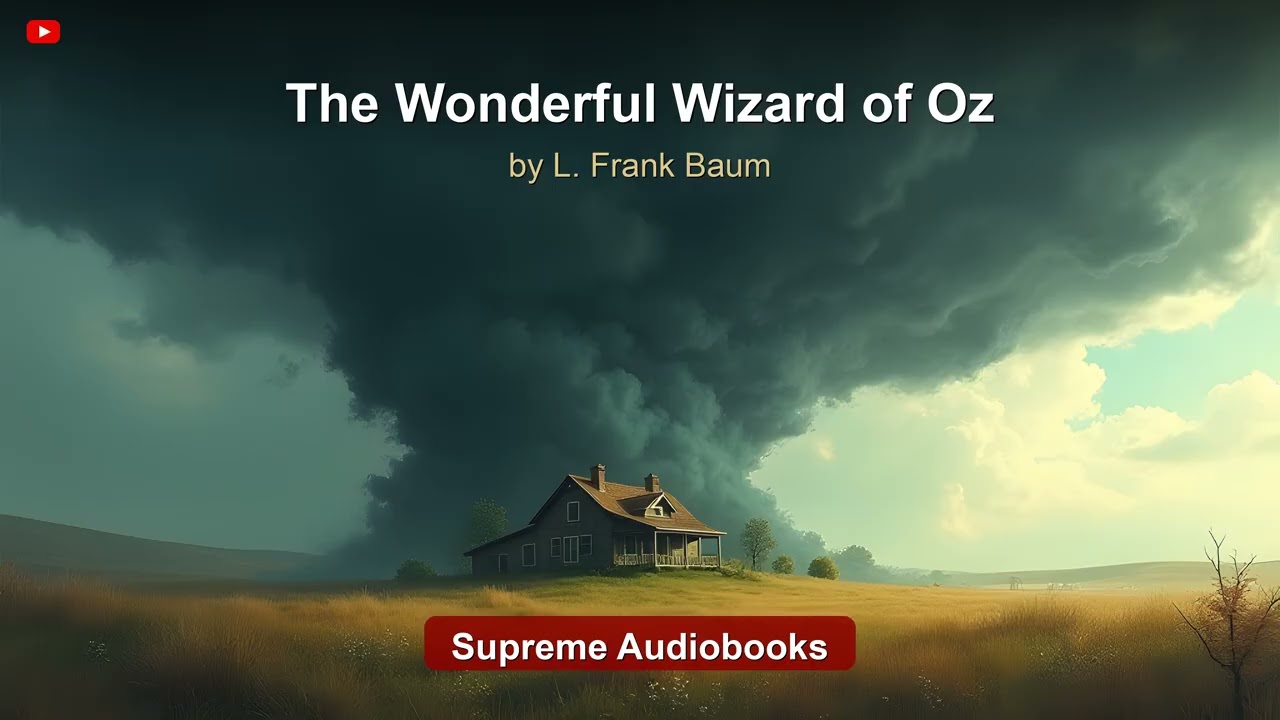
The 4K cinematic visuals accompanying this audiobook are generated by an AI image model from prompts derived from the source text. No copyrighted photos, paintings, or stock footage are used. AI generation is disclosed on every video on our YouTube channel as required by YouTube's altered/synthetic content policy.
English subtitles are transcribed from the LibriVox recording with OpenAI Whisper. Translations into the 11 other supported languages are produced by Meta's NLLB-200 neural translation model. No human translator's copyrighted translation is used.
Questions about sourcing or rights? See our DMCA & Sourcing policy or contact us.
Enjoyed this audiobook?
If you'd like to own a copy of The Wonderful Wizard of Oz or hear a professionally produced edition, the links below help support free audiobook production at no extra cost to you.
As an Amazon Associate we earn from qualifying purchases. Audible / print links are affiliate.