Heart of Darkness
There are few stories that pierce the veil of human morality with the stark, unforgettable clarity of Joseph Conrad's Heart of Darkness. This slender novella, originally published in 1899, remains a vital and disturbing meditation on the darkness that can reside not only in remote corners of the world but within the human soul itself. More than a century after its first appearance, its unflinching examination of colonialism's brutal impact, the corrupting influence of unchecked power, and the precariousness of so-called civilization continues to resonate, forcing listeners to confront uncomfortable truths about history and themselves. It is a haunting descent into the psychological abyss that, once heard, will lodge itself in the mind's eye. The narrative unfolds through the voice of Charlie Marlow, an experienced seaman recounting a pivotal, unsettling episode from his past to a group of fellow sailors anchored idly on the River Thames. Marlow's tale begins innocently enough, a professional assignment to pilot a steamboat up the mighty Congo River for a shadowy European ivory trading company. This is an era of fervent colonial expansion, and the interior of Africa represents both a land of opportunity and a place of profound mystery. As Marlow travels deeper into the continent, he witnesses firsthand the casual cruelty and systemic exploitation visited upon the indigenous people by the European agents—scenes of senseless destruction, forced labor, and an overwhelming sense of moral decay pervading the stations. Marlow's primary mission, however, is to locate Kurtz, a highly successful but increasingly enigmatic ivory agent operating deep within the remote territories. Rumors precede Kurtz, painting him as a prodigy, a brilliant orator, a man of remarkable influence who sends out vast quantities of ivory from his inner station. Yet, these same whispers also hint at something profoundly disturbing, a man who has transcended the norms of European society in a way that inspires both awe and dread. Marlow's journey becomes a relentless pursuit of this legendary figure, a slow, arduous progression up a river that feels like a serpentine path into a forgotten and hostile world. The physical landscape mirrors the psychological terrain, becoming ever more primeval and menacing, until Marlow finally reaches Kurtz's outpost, a place where the distinctions between civilization and savagery appear to have dissolved completely. The author behind this powerful and enduring work was Józef Teodor Konrad Korzeniowski, born in 1857 in what is now Ukraine, then part of the Russian Empire. Orphaned at a young age, Conrad—as he would later be known—chose a life at sea, a decision that would profoundly shape his literary output. He became a merchant marine, serving for nearly two decades in various capacities, traveling across the globe to places as diverse as the South Pacific, the Indian Ocean, and, most crucially, the Congo. His experiences during a brief but intense period as a steamboat captain on the Congo River in 1890 directly informed the chilling realism of Heart of Darkness. Remarkably, Conrad did not begin writing fiction until his late thirties, and English was his third language, yet he went on to become one of the most celebrated stylists in English literature. His remarkable command of the English language, despite its later adoption, allowed him to craft intricate psychological narratives. Beyond Heart of Darkness, Conrad produced a body of work that consistently examined the human condition under extreme pressure, often in exotic or isolated settings. His other notable novels include Lord Jim, a story of moral failure and redemption; Nostromo, a sweeping tale of revolution and materialism in a fictional South American country; and The Secret Agent, a dark political thriller set in London. Often associated with literary realism and early Modernism, Conrad's works typically probe themes of isolation, duty, honor, and the moral ambiguities inherent in human action, securing his place as a towering figure in the English literary canon. He died in England in 1924, leaving behind an indelible mark on prose fiction. At its core, Heart of Darkness confronts listeners with several potent themes. Perhaps the most prominent is the scathing critique of European colonialism. Conrad vividly portrays the destructive impact of the "civilizing mission," revealing it to be a thinly veiled pursuit of profit and power, devoid of genuine humanitarian concern. We see this in the horrifying "grove of death" where discarded, dying indigenous laborers lie, or in the senseless blasting of a hillside with no clear purpose beyond a crude show of force. This imperialistic greed strips away the humanity of both the colonized and the colonizer. Another central theme is the fragility of civilization and the inherent potential for savagery within all humans. As Marlow travels upriver, the structures and norms of European society steadily erode, culminating in Kurtz's terrifying descent into primal, unchecked rule. Kurtz, initially hailed as an emissary of light and progress, ultimately succumbs to the "heart of darkness" within himself, collecting human heads on fence posts and issuing the chilling command to "Exterminate all the brutes!"—a stark testament to the veneer of civilization being peeled back. The novella also grapples with the corrupting influence of absolute power and the elusiveness of truth. Isolated from accountability, Kurtz transforms from an idealistic agent into a tyrannical god-figure, worshipped and feared. His power allows his darkest impulses free rein. Marlow’s quest to understand Kurtz becomes a search for an elusive truth, a truth obscured by lies, rumors, and the overwhelming, disorienting atmosphere of the wilderness. Conrad suggests that some truths are too terrible to be faced directly, and that language itself may be insufficient to convey the profound moral horror Marlow witnesses. When Heart of Darkness was published at the tail end of the nineteenth century, Europe was in the throes of the "Scramble for Africa." Major European powers were aggressively carving up the African continent into colonies, ostensibly for reasons of trade, resource extraction, and spreading "civilization" and Christianity. The Congo Free State, under the personal rule of Belgium's King Leopold II, was a particularly brutal example of this imperialistic fervor, characterized by horrific atrocities against the native population for the extraction of rubber and ivory. Conrad's novella emerged as a powerful counter-narrative to the prevailing, often romanticized, public image of colonial expansion. It challenged the triumphalist narratives of progress and highlighted the immense human cost. The work reflected a growing anxiety in the literary world about the moral implications of empire and the changing understanding of human nature itself, moving away from simple Victorian optimism towards more complex, often darker, psychological realism. Listening to Heart of Darkness as an audiobook offers a singular opportunity to immerse oneself in its dense atmosphere and chilling introspection. A skilled narrator can bring to life Marlow's distinctive, measured voice—his initial detachment giving way to growing horror and profound weariness. The approximately four-hour runtime makes it ideal for focused listening, perhaps during a contemplative walk or a series of commutes, allowing the listener to absorb the intricate prose without rushing. Pay close attention to the deliberate pacing, which mirrors the slow, inexorable journey up the Congo River, building tension with each passing mile. The subtle vocalizations of the various Company agents, each revealing their own degrees of moral compromise, contribute to the sense of a world gone awry. Most importantly, the narration can amplify the eerie silence and disquieting sounds Conrad evokes, making the desolate beauty and the underlying menace of the setting truly palpable, allowing the "heart of darkness" to beat within the listener's own mind.
Enjoyed Heart of Darkness? A few ways to support us
Audible & Amazon links are affiliate; we may earn a small commission at no extra cost.
About this production
Human narration by a volunteer reader from LibriVox.org, the public-domain audiobook project. LibriVox volunteers record literary works whose copyright has expired in the United States, releasing the resulting recordings into the public domain.
Heart of Darkness, first published in 1899 by Joseph Conrad. The underlying text is in the U.S. public domain. We do not republish any modern copyrighted edition, translation, or commentary.
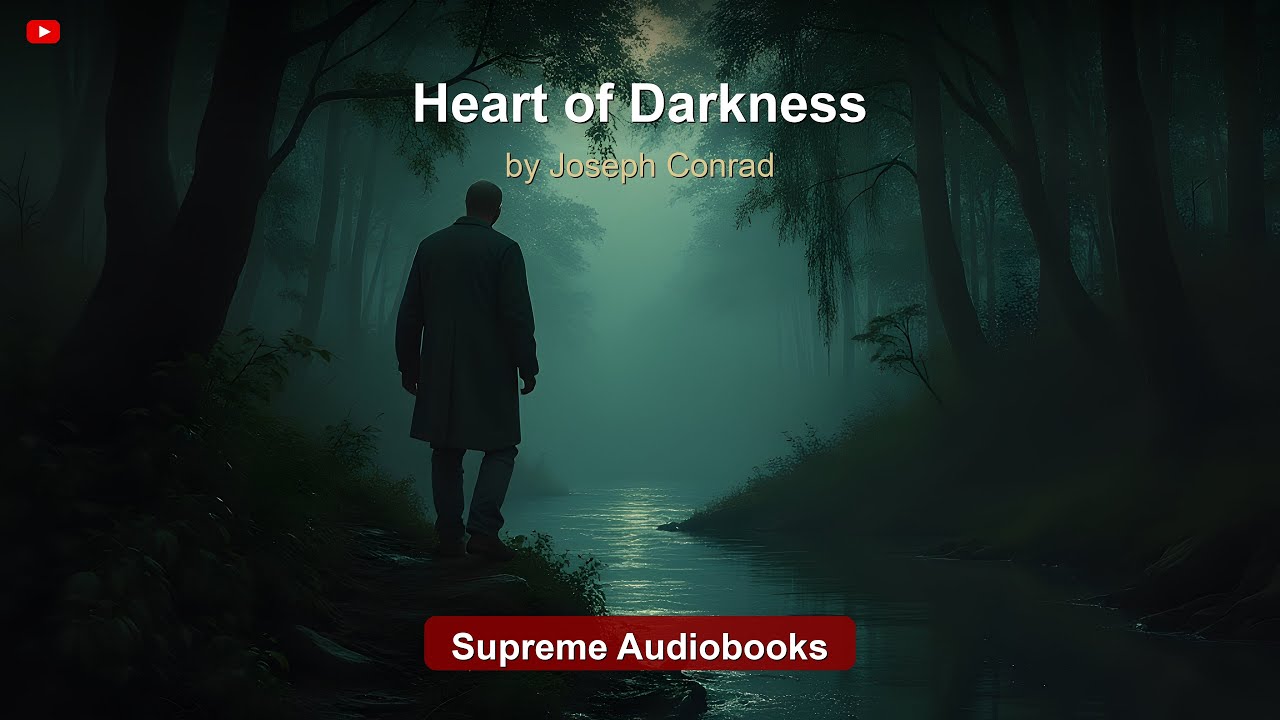
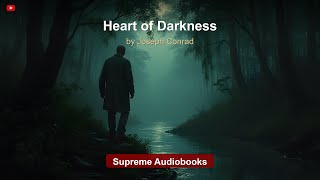
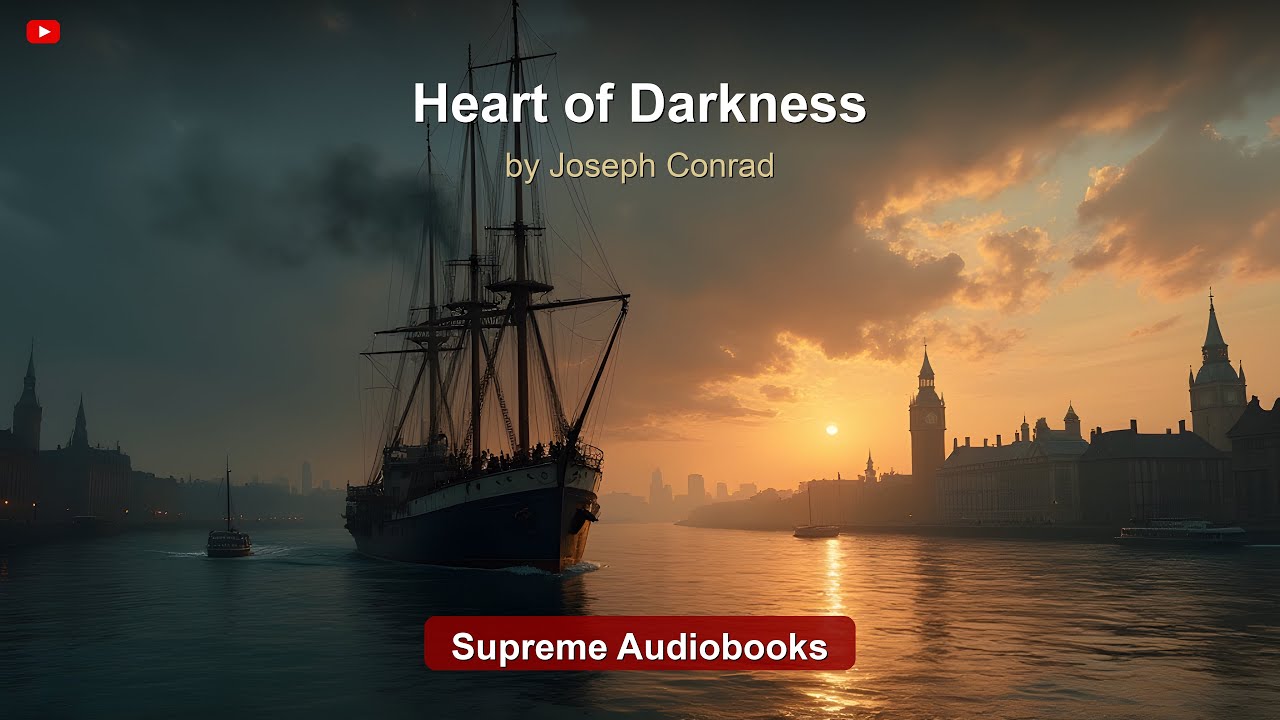
The 4K cinematic visuals accompanying this audiobook are generated by an AI image model from prompts derived from the source text. No copyrighted photos, paintings, or stock footage are used. AI generation is disclosed on every video on our YouTube channel as required by YouTube's altered/synthetic content policy.
English subtitles are transcribed from the LibriVox recording with OpenAI Whisper. Translations into the 11 other supported languages are produced by Meta's NLLB-200 neural translation model. No human translator's copyrighted translation is used.
Questions about sourcing or rights? See our DMCA & Sourcing policy or contact us.
Enjoyed this audiobook?
If you'd like to own a copy of Heart of Darkness or hear a professionally produced edition, the links below help support free audiobook production at no extra cost to you.
As an Amazon Associate we earn from qualifying purchases. Audible / print links are affiliate.