The Time Machine
Before Einstein conceived of relativity, before the DeLorean sped to the past, and long before a blue police box materialized on screens, there was H. G. Wells’s Time Traveller. Published in 1895, The Time Machine did not just popularize the concept of traveling through the fourth dimension; it invented it for popular audiences, forever cementing its place as the foundational text of science fiction and a searing social commentary. This brief, electrifying novella invites listeners to confront not only the boundless potential of scientific invention but also the unsettling possibilities of humanity’s ultimate fate, presenting a vision of the future that remains disturbingly relevant more than a century later. The story begins in the intellectual atmosphere of late 19th-century London, amidst a gathering of scientific gentlemen in the home of the unnamed Time Traveller. He regales his skeptical guests with an improbable claim: he has constructed a machine capable of moving through time itself. After a brief, unconvincing demonstration with a miniature model, the guests return a week later to find their host disheveled and shaken. He recounts an incredible adventure, beginning with his solo voyage eight hundred millennia into the future, to the year 802,701 AD. He describes landing in a seemingly idyllic world, a paradise of lush gardens and flowing rivers, inhabited by the Eloi—small, graceful, childlike beings who spend their days in playful idleness. Initially, the Time Traveller believes he has discovered a perfect, utopian society, the pinnacle of human evolution where struggle and toil have been abolished. His optimism, however, quickly gives way to unease as he notices the Eloi’s lack of curiosity, their fragility, and a strange, deep-seated fear of the dark. When his time machine mysteriously vanishes, he is forced to confront the true, terrifying nature of this future world. Beneath the pastoral surface, lurking in the subterranean tunnels of the planet, exists another species: the Morlocks. These ape-like, nocturnal creatures tend the massive underground machinery that supports the Eloi’s existence, but they also hold a sinister sway over their surface-dwelling cousins. The Time Traveller’s struggle to retrieve his machine and escape this devolved future becomes a desperate fight for survival and understanding against forces far more primal than any he could have imagined. The mind behind such prescient imaginings belonged to Herbert George Wells, an English writer born in Bromley, Kent, in 1866. His early life was marked by financial struggles and varied apprenticeships, from draper to chemist, experiences that undoubtedly shaped his keen awareness of social class and economic inequality. A scholarship to the Normal School of Science in London allowed him to study biology under the renowned scientist T. H. Huxley, grandfather of Aldous Huxley, an education that provided a strong scientific foundation for his imaginative leaps. Wells initially worked as a teacher before dedicating himself fully to writing, and his scientific training deeply influenced his early works, often dubbed "scientific romances." He would later become a prolific author, producing not only influential science fiction but also realistic novels, social commentaries, and historical works. Wells was a true visionary, credited alongside Jules Verne as a father of science fiction. His enduring contributions to the genre include popularizing concepts like time travel, alien invasion, and genetic engineering through works such as The Invisible Man, The War of the Worlds, and The Island of Doctor Moreau. Beyond his fantastical narratives, Wells was a vocal socialist and social critic, using his fiction as a vehicle to critique Victorian society, advocate for social reform, and speculate on humanity's potential for both progress and self-destruction. He passed away in London in 1946, leaving behind a literary legacy that continues to resonate with readers and inspire generations of authors and scientists. The Time Machine offers a stark examination of several profound themes. At its heart lies a chilling indictment of Victorian class divisions, manifested through the Eloi and Morlocks. Wells extrapolates the existing gap between the leisured upper classes and the industrial working class, suggesting that unchecked social stratification could lead to a horrifying biological divergence, with the former becoming weak and dependent, and the latter strong but brutal. The Time Traveller’s initial wonder at the Eloi's seemingly idyllic life quickly turns to horror as he comprehends their childlike helplessness and the sinister relationship they share with the underground Morlocks, revealing a dystopian reality beneath a utopian veneer. Furthermore, the novella confronts the unsettling possibility of human degeneration. Wells challenges the prevailing Victorian belief in inevitable human progress, painting a future where intelligence and vitality have atrophied, replaced by either pampered complacency or savage necessity. The Time Traveller observes the Eloi’s fading intellectual curiosity and physical frailty, contrasting them with the Morlocks' evolution into pale, predatory nocturnal creatures driven by instinct. This unsettling vision forces a consideration of humanity's place in the vast sweep of evolutionary time, prompting questions about what truly constitutes "progress" and the potential costs of societal comfort. The book’s emergence in 1895 placed it firmly within the fin de siècle anxieties of the late Victorian era. It was a time of immense scientific and technological upheaval—Darwin's theories of evolution by natural selection had shaken traditional views of humanity's origins, while the Industrial Revolution had irrevocably reshaped society, creating unprecedented wealth alongside stark poverty and fueling fears of social unrest. Wells, a keen observer of these changes, channeled these societal tensions into his narrative. The British Empire was at its zenith, but undercurrents of doubt about its future, alongside a growing fascination with the macabre and the unknown, permeated the cultural landscape. The Time Machine reflects these fears, acting as a cautionary tale born from the very height of industrial confidence and imperial power. To truly experience the Time Traveller's journey, listening to it as an audiobook provides an unparalleled opportunity to immerse oneself in Wells's vision. At a concise 3 hours and 45 minutes, it’s a perfect length for a single intense listening session or to accompany a couple of commutes. Listen for the narrator’s careful pacing, which builds from the calm, intellectual discussions of the initial London scenes to the growing sense of dread and frantic action in the far future. The voice acting brings the Time Traveller’s wide-eyed wonder, his dawning horror, and his desperate resilience to life, creating a palpable sense of atmosphere—from the deceptive tranquility of the Eloi’s world to the chilling, mechanical thrum of the Morlock tunnels. It allows the listener to walk alongside him through a world both alien and eerily familiar, hearing the very echoes of a future that, perhaps, humanity still has the power to change.
Enjoyed The Time Machine? A few ways to support us
Audible & Amazon links are affiliate; we may earn a small commission at no extra cost.
About this production
Human narration by a volunteer reader from LibriVox.org, the public-domain audiobook project. LibriVox volunteers record literary works whose copyright has expired in the United States, releasing the resulting recordings into the public domain.
The Time Machine, first published in 1895 by H. G. Wells. The underlying text is in the U.S. public domain. We do not republish any modern copyrighted edition, translation, or commentary.
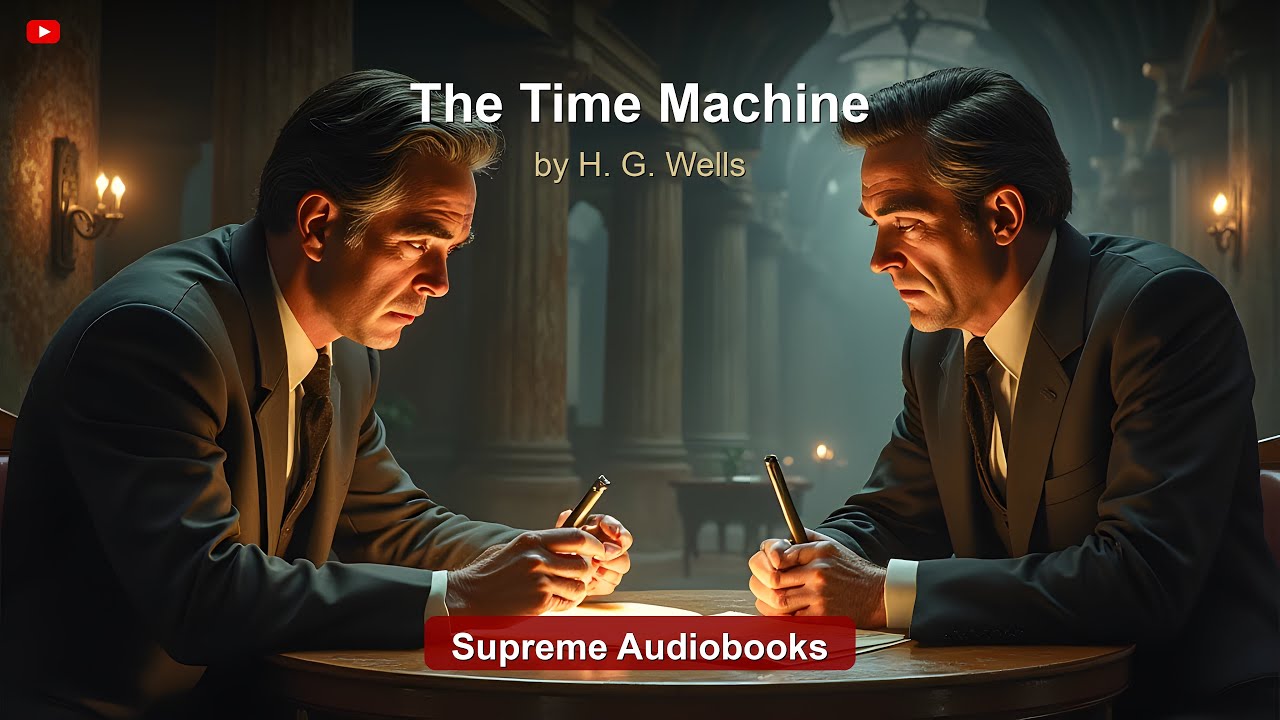
The 4K cinematic visuals accompanying this audiobook are generated by an AI image model from prompts derived from the source text. No copyrighted photos, paintings, or stock footage are used. AI generation is disclosed on every video on our YouTube channel as required by YouTube's altered/synthetic content policy.
English subtitles are transcribed from the LibriVox recording with OpenAI Whisper. Translations into the 11 other supported languages are produced by Meta's NLLB-200 neural translation model. No human translator's copyrighted translation is used.
Questions about sourcing or rights? See our DMCA & Sourcing policy or contact us.
Enjoyed this audiobook?
If you'd like to own a copy of The Time Machine or hear a professionally produced edition, the links below help support free audiobook production at no extra cost to you.
As an Amazon Associate we earn from qualifying purchases. Audible / print links are affiliate.