Studies in Folk Song and Popular Poetry
Step into a unique auditory space where the echoes of forgotten voices meet the keen analytical mind of a late-Victorian scholar. Alfred Williams' Studies in Folk Song and Popular Poetry, originally published in 1895, is not merely a historical document; it is an enduring invitation to consider the profound, often unacknowledged, wellsprings of human creativity. Why should a listener care about this specific collection of literary criticism today? Because it offers a vital lens through which to understand how popular expression – the songs sung in fields, the rhymes recited by firesides, the verses sold on street corners – shapes culture, preserves history, and gives voice to generations whose experiences might otherwise remain unheard. It challenges us to look beyond the printed page and appreciate the living, breathing tradition of storytelling and song that continues to resonate in our own contemporary forms of popular media and artistic output, offering a foundational understanding of the bedrock upon which much of our modern entertainment and cultural identity stands. Alfred Williams commences his intellectual expedition not with grand theory, but with the very essence of human utterance: the common, unadorned song and verse. His project sets out to survey a literary landscape far removed from the hallowed halls of academia, a realm populated by anonymous bards, spontaneous rhymesters, and the collective memory of communities. He acts as a diligent archivist and an astute interpreter, guiding his reader through the diverse forms that folk song and popular poetry assume. From the solemn ballad recounting ancient tragedies or local skirmishes, to the boisterous street cry, the nursery rhyme passed down through generations, and the often biting satire of political broadsides, Williams introduces us to these transient yet powerful works. He establishes the "setting" as the hearth, the workshop, the public square—anywhere where human life unfolds and finds musical or poetic expression, often outside formal literary channels. The main "characters" in Williams' study are, in a sense, the songs and poems themselves, each imbued with the spirit of its creators and the times it represents. These lyrical entities often reflect the lives of ordinary people: their toil, their loves, their losses, their aspirations, and their frustrations. Williams' central "conflict" is the endeavor to retrieve, categorize, and critically assess this vast, diffuse body of oral and ephemeral literature, confronting the academic prejudices that often relegated such material to mere curiosities rather than legitimate subjects of scholarly inquiry. He systematically addresses questions of authorship (or lack thereof), transmission, linguistic variation, and thematic recurrence. The "arc" of his investigation moves from broad definitions of folk song to detailed examinations of specific genres and examples, building a compelling argument for their intrinsic artistic merit and cultural significance. He dissects the poetic techniques, the narrative structures, and the emotional resonance of seemingly simple verses, revealing their often sophisticated craftsmanship and profound impact. Through his careful analysis, Williams makes a forceful case for understanding these often-overlooked creations not as primitive utterances, but as sophisticated expressions of collective human experience. The author, Alfred Williams, published this particular scholarly volume in 1895. While precise biographical details for this specific Alfred Williams are scarce in readily accessible records, indicating he may have been a dedicated amateur scholar, a regional antiquarian, or an independent literary critic rather than a prominent academic of his day, the insights offered within Studies in Folk Song and Popular Poetry speak volumes about his meticulous approach and profound appreciation for grassroots culture. His work aligns with a broader intellectual current of the late nineteenth century, where scholars began to recognize the value of oral traditions and popular expressions as sources of historical, linguistic, and cultural knowledge. This Williams demonstrates a keen ear for dialect, an understanding of social history, and an impressive breadth of reading in both established literature and the more ephemeral forms he champions. He stands as a testament to the passionate, often self-taught individuals who contributed significantly to the burgeoning field of folklore studies during a period when the academic landscape was just beginning to acknowledge the richness of non-canonical materials. His method, characterized by careful cataloging and insightful commentary, reflects the spirit of an age fascinated by origins, classifications, and the hidden narratives embedded in everyday life. Though not widely associated with a specific literary movement, his work undoubtedly contributes to the late Victorian tradition of cultural preservation and the emerging discipline of comparative literature, demonstrating a scholarly rigor applied to subjects often deemed beneath serious critical attention. The absence of extensive personal biography in no way diminishes the enduring value of his intellectual contribution, allowing the work itself to stand as a primary indicator of his scholarly interests and the intellectual climate he inhabited. Williams' study enacts several key themes that resonate powerfully even today. One central theme is the preservation of cultural heritage. He acts as a literary archaeologist, digging through forgotten broadsides, transcribing spoken songs, and annotating verses that might otherwise have been lost to the relentless march of time. For example, his detailed accounts of regional harvest songs or local laments, complete with linguistic notes, highlight the urgency of recording these ephemeral expressions before they vanished with the changing rural landscape and increasing urbanization. Another significant theme is the voice of the common person. Williams consistently champions folk song and popular poetry as the authentic, unvarnished expression of ordinary people, often providing perspectives absent from official histories or elite literature. He might analyze a protest song sung by factory workers or a ballad recounting a domestic tragedy, demonstrating how these pieces gave agency and voice to those at the margins of society, offering a raw, emotional truth that more polished verse sometimes lacked. A third theme he illuminates is the evolution and adaptation of oral traditions. Williams shows how a song or poem is not a static artifact but a living entity, constantly undergoing transformation as it passes from singer to singer, generation to generation, and region to region. He might present multiple versions of a familiar nursery rhyme or a traditional ballad, meticulously comparing their variations in wording, plot details, or moral emphasis to illustrate how these stories adapt to new contexts and audiences while retaining their core narrative power. Finally, his work subtly explores the relationship between "high" and "low" art, implicitly arguing for the inherent aesthetic value of popular forms. By dissecting the structural sophistication of a simple rhyme or the emotional depth of a seemingly unadorned ballad, Williams elevates these often-dismissed works, suggesting they possess their own unique forms of beauty, poetic craft, and social utility, deserving of the same critical attention given to canonical literature. The year 1895, when Studies in Folk Song and Popular Poetry appeared, situated it squarely within the late Victorian era—a period marked by dramatic social, economic, and technological upheaval. Industrialization had transformed much of Britain, drawing populations from rural areas into burgeoning cities, and threatening traditional ways of life. This societal shift fueled a growing interest in folklore and national heritage, often seen as a bulwark against the perceived anomie of modern life. Academically, the late nineteenth century was a fertile ground for the nascent field of folklore studies, with societies like The Folklore Society (founded in 1878) actively collecting and disseminating traditional materials. Seminal works like Francis James Child's monumental English and Scottish Popular Ballads were nearing completion, establishing rigorous standards for collecting and annotating folk songs. Against this backdrop, Williams' work emerged as part of a broader cultural movement to document and understand the oral and popular traditions that were thought to be rapidly disappearing. There was a prevailing sense that the "authentic" voices of the past, preserved in song and verse, were being eroded by mass print culture, compulsory education, and the homogenizing forces of modern urban life. Scholars and enthusiasts alike felt an urgency to record these expressions before they were irretrievably lost. Politically, the era also saw debates around social reform, labor movements, and national identity, all of which often found expression in the very popular poetry and songs that Williams sought to analyze, making his study not just an academic exercise but a contribution to understanding the social fabric of his time. Listening to Studies in Folk Song and Popular Poetry as an audiobook brings a unique resonance to Williams' meticulous analysis. Given that folk songs and popular poetry are, at their heart, forms meant for oral transmission and performance, hearing Williams' scholarship read aloud feels inherently appropriate. The narrator's voice transforms what might otherwise be dense academic prose into a more engaging, accessible experience. Over a run length of nearly seven hours (6h 53m), the listener has ample time to absorb Williams' arguments, to ponder his examples, and to appreciate the nuances of his scholarly approach without the visual strain of reading a historical text. The pacing of a skilled narration can guide the listener through Williams' detailed comparisons and linguistic observations, making complex ideas more digestible. One can focus on the rhythmic flow of the historical examples Williams cites, perhaps even imagining the original performances of the songs and verses he describes, thereby enhancing the atmospheric connection to the material. This audio format allows Williams' passion for his subject to shine through, creating a scholarly yet deeply human experience that honors the very oral traditions he so diligently investigates.
Enjoyed Studies in Folk Song and Popular Poetry? A few ways to support us
Audible & Amazon links are affiliate; we may earn a small commission at no extra cost.
About this production
Human narration by a volunteer reader from LibriVox.org, the public-domain audiobook project. LibriVox volunteers record literary works whose copyright has expired in the United States, releasing the resulting recordings into the public domain.
Studies in Folk Song and Popular Poetry, first published in 1895 by Alfred Williams. The underlying text is in the U.S. public domain. We do not republish any modern copyrighted edition, translation, or commentary.
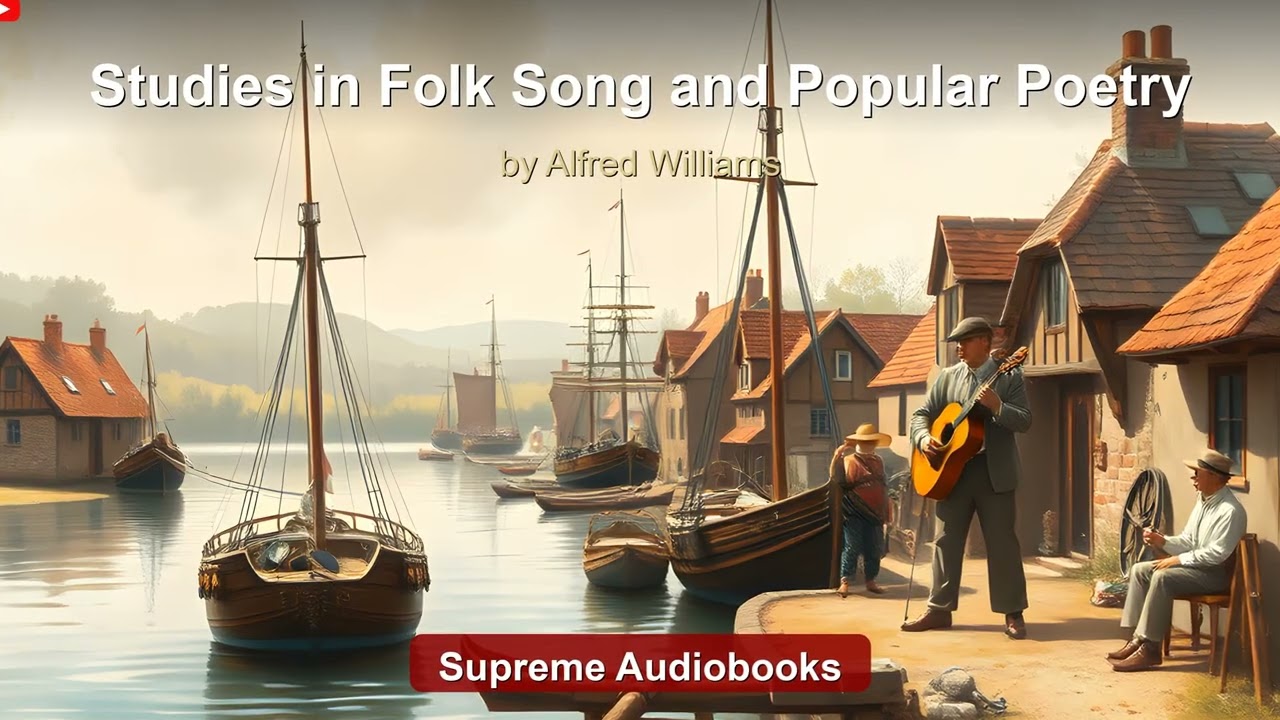
The 4K cinematic visuals accompanying this audiobook are generated by an AI image model from prompts derived from the source text. No copyrighted photos, paintings, or stock footage are used. AI generation is disclosed on every video on our YouTube channel as required by YouTube's altered/synthetic content policy.
English subtitles are transcribed from the LibriVox recording with OpenAI Whisper. Translations into the 11 other supported languages are produced by Meta's NLLB-200 neural translation model. No human translator's copyrighted translation is used.
Questions about sourcing or rights? See our DMCA & Sourcing policy or contact us.
Enjoyed this audiobook?
If you'd like to own a copy of Studies in Folk Song and Popular Poetry or hear a professionally produced edition, the links below help support free audiobook production at no extra cost to you.
As an Amazon Associate we earn from qualifying purchases. Audible / print links are affiliate.