Studies and Essays: Quality and Others
Step into the discerning mind of John Galsworthy, Nobel laureate and keen observer of human nature, with Studies and Essays: Quality and Others. Published in 1914, on the cusp of a world-altering conflict, this collection offers a vital and surprisingly contemporary window into the values and anxieties of an age grappling with rapid change. It’s a compelling gathering of reflections that reveal Galsworthy's profound commitment to integrity, beauty, and social justice, demonstrating why his voice remains so relevant today, urging us to consider what "quality" truly means in our own lives and societies. For anyone seeking to understand the ethical and aesthetic questions that persist across generations, these essays offer both solace and spirited challenge. This collection, rather than presenting a conventional narrative, guides us through a series of Galsworthy's intellectual and emotional landscapes. He functions as our perceptive guide, inviting us to contemplate subjects as varied as the quiet dignity of an artisan, the fleeting beauty of nature, the often-flawed mechanisms of justice, and the sometimes-stifling conventions of society. The setting is primarily the human condition itself, observed through the lens of early 20th-century English life, yet consistently elevating to universal insights. There are no "characters" in the fictional sense, save for Galsworthy himself as the reflective consciousness, and the occasional human figures he observes, their lives becoming illustrations of broader truths. The central conflict, if one can call it that in an essay collection, lies in the perpetual human struggle to uphold values of excellence and genuine worth against the pressures of expediency, materialism, and societal indifference. The most renowned piece, "Quality," provides a poignant example. It introduces us to Mr. Gessler, a German bootmaker in London whose dedication to his craft borders on the sacred. His boots are not merely footwear; they are works of art, imbued with his skill and soul, made to last and to fit perfectly. We follow Gessler's quiet, unwavering commitment to his trade, observing the slow, inevitable decline of his small, independent shop in the face of burgeoning industrialization and mass production. This particular story doesn't resolve in triumph but rather leaves us contemplating the true cost of convenience and the fading art of true craftsmanship, a dilemma that echoes across the entire collection. John Galsworthy, born in 1867 in Kingston Hill, Surrey, England, was a product of the Victorian era but became one of the defining literary voices of the Edwardian and Georgian periods. Educated at Harrow School and New College, Oxford, where he studied law, he initially practiced reluctantly before succumbing to his true calling. A pivotal meeting at sea with Joseph Conrad proved instrumental in encouraging his literary ambitions. Galsworthy initially published under the pseudonym John Sinjohn, but soon found fame under his own name, becoming known for his elegant prose and his critical yet sympathetic gaze upon the English upper-middle classes. His personal life, particularly his marriage to Ada Nemesis Pearson Cooper, formerly his cousin's wife, which was considered scandalous for its time, deeply informed his empathetic understanding of societal constraints and the often-hypocritical nature of morality and law. Galsworthy was not merely an observer; he was a moralist, driven by a profound sense of social justice. His most celebrated achievement is The Forsyte Saga, a sweeping series of novels chronicling the lives of a wealthy, property-owning family through several generations, serving as a powerful social critique. Other notable works include the plays Strife and Justice, which likewise grappled with issues of class conflict and the flaws within the legal system. He was awarded the Nobel Prize in Literature in 1932, a testament to his lasting impact, and famously declined a knighthood, consistent with his independent spirit and critique of establishment honors. The essays gathered here enact several key themes that resonate throughout Galsworthy's broader body of work. Foremost among them is the poignant concern for the pursuit of "quality" and craftsmanship in an increasingly commercialized world. The tale of Mr. Gessler, the bootmaker, is the clearest illustration, a quiet protest against the dehumanizing aspects of rapid industrial progress that sacrifices excellence for expediency. Galsworthy mourns the loss of individual skill and the dignity of devoted labor, a sentiment that extends beyond mere shoemaking to encompass all forms of human endeavor where genuine worth is undervalued. Another dominant theme is social justice and a critique of class divisions, though often presented with subtle grace rather than overt polemic. Galsworthy repeatedly highlights the inherent dignity of individuals, regardless of their social standing, and questions the arbitrary nature of wealth and privilege, often contrasting them with true human integrity and compassion. These essays also illuminate Galsworthy's deep appreciation for human dignity and compassion. His gaze falls most kindly upon those often overlooked or marginalized by society, finding profound worth in their struggles and quiet resilience. He consistently advocates for a more humane and understanding approach to human affairs, tempering his social critique with a gentle, often melancholic, empathy. Finally, the collection itself stands as a testament to the power of observation and reflection. Galsworthy's strength lies in his ability to distill universal truths from specific instances, encouraging us to look closer at the world around us and consider the ethical implications of our choices and societal structures. These non-fiction pieces offer a direct conduit to the values that underpin his masterful fictional creations. When Studies and Essays: Quality and Others was published in 1914, Europe stood on the brink of profound, unimaginable change. The anxieties preceding World War I were palpable, though perhaps not fully articulated, and society was wrestling with the consequences of vast industrialization, shifting class structures, and burgeoning social movements like the suffragettes. Galsworthy, already a prominent figure in the literary landscape, was uniquely positioned to articulate these undercurrents. His essays reflect a pre-war sensibility, a longing for certain values of integrity, art, and human decency that he perceived as eroding in an increasingly mechanized and impersonal world. They represent his direct engagement with the ideas bubbling beneath the surface of the grand social dramas he penned in his novels and plays, offering his direct commentary on the moral and aesthetic dilemmas of his time. This collection speaks to a moment of significant transition, capturing the ethical pulse of an era poised for a dramatic redefinition of itself. Listening to Studies and Essays: Quality and Others as an audiobook offers a unique opportunity to immerse oneself in Galsworthy’s measured and articulate prose. A skilled narrator brings his thoughtful, often poignant, and subtly ironic voice directly to the listener, allowing the full weight and beauty of his sentences to unfold. The relatively short run length of 1 hour and 43 minutes makes it an ideal companion for a commute, a quiet afternoon, or a series of reflective moments. Listen for the deliberate pacing, which mirrors Galsworthy’s contemplative style, and the narrator’s ability to convey the nuanced opinions, profound compassion, and occasional sharpness of the author. The audio format particularly enhances the atmosphere of Edwardian reflection, allowing the listener to feel directly addressed by a wise, discerning mind, making each essay a personal conversation about enduring truths.
Enjoyed Studies and Essays: Quality and Others? A few ways to support us
Audible & Amazon links are affiliate; we may earn a small commission at no extra cost.
About this production
Human narration by a volunteer reader from LibriVox.org, the public-domain audiobook project. LibriVox volunteers record literary works whose copyright has expired in the United States, releasing the resulting recordings into the public domain.
Studies and Essays: Quality and Others, first published in 1914 by John Galsworthy. The underlying text is in the U.S. public domain. We do not republish any modern copyrighted edition, translation, or commentary.
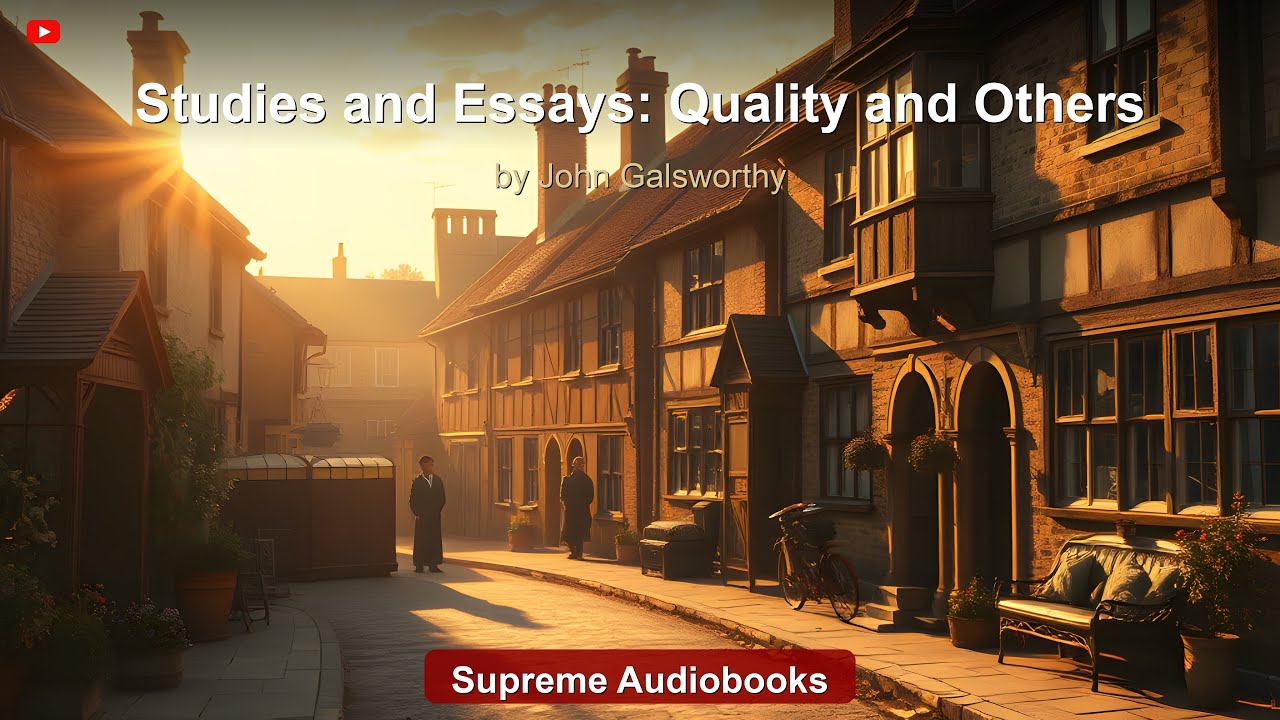
The 4K cinematic visuals accompanying this audiobook are generated by an AI image model from prompts derived from the source text. No copyrighted photos, paintings, or stock footage are used. AI generation is disclosed on every video on our YouTube channel as required by YouTube's altered/synthetic content policy.
English subtitles are transcribed from the LibriVox recording with OpenAI Whisper. Translations into the 11 other supported languages are produced by Meta's NLLB-200 neural translation model. No human translator's copyrighted translation is used.
Questions about sourcing or rights? See our DMCA & Sourcing policy or contact us.
Enjoyed this audiobook?
If you'd like to own a copy of Studies and Essays: Quality and Others or hear a professionally produced edition, the links below help support free audiobook production at no extra cost to you.
As an Amazon Associate we earn from qualifying purchases. Audible / print links are affiliate.