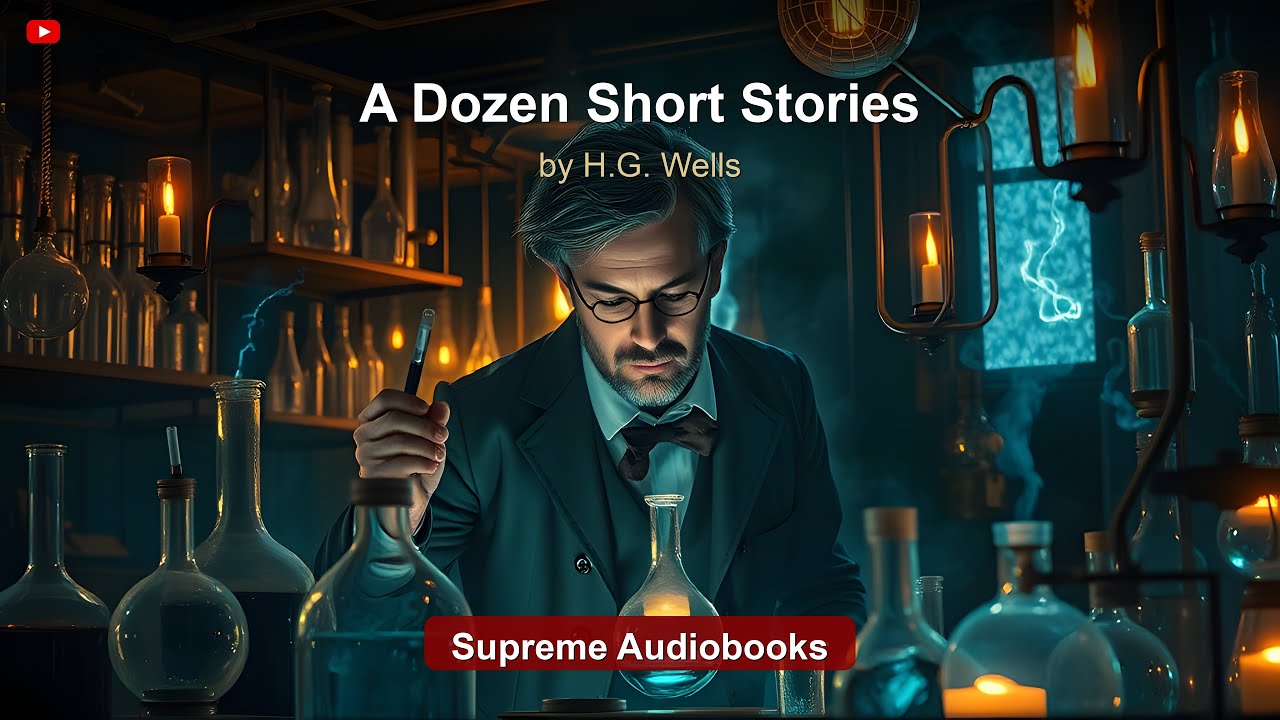
A Dozen Short Stories
Step into the imaginative world of H. G. Wells, a visionary whose stories continue to resonate more than a century after their creation. A Dozen Short Stories, published in 1903, offers a potent distillation of Wells's genius, showcasing his remarkable ability to blend scientific speculation with poignant human drama. This collection is not merely a historical curiosity; it is a foundational text in science fiction, where the familiar world brushes against the utterly strange, prompting us to reconsider our place in the universe. Listening to these tales today allows us to experience the genesis of many ideas that still shape our understanding of possible futures and the peculiar corners of the human mind. This collection presents a varied panorama of Wells's shorter fiction, inviting listeners into distinct worlds of wonder and disquiet. You might find yourself observing the cosmic indifference of a rogue celestial body in "The Star," where humanity's precarious existence is illuminated by an impending, cataclysmic event. Or perhaps you'll witness the strange enchantment of "The Magic Shop," where a father and son encounter a store that defies the laws of physics, blurring the lines between illusion and reality with unsettling ease. Wells often grounds his narratives in the recognizable landscapes of Edwardian England, only to introduce an element so profoundly alien or technologically advanced that it shatters conventional understanding. His characters are often ordinary individuals—scientists, shopkeepers, curious onlookers—who find their lives irrevocably altered by encounters with the unknown, whether it is an invention gone awry or a sudden, inexplicable phenomenon. Each story in the collection acts as a self-contained thought experiment, probing the consequences of scientific discovery, the nature of perception, and the often-fragile foundations of civilization. Herbert George Wells, born in Bromley, Kent, England, in 1866, overcame a challenging early life as the son of a shopkeeper to become one of the most influential writers of the modern era. His formative years included apprenticeships in various trades, experiences that undoubtedly fueled his later critiques of social class and economic inequality. A pivotal moment in his intellectual development came with a science scholarship to the Normal School of Science (now part of Imperial College London), where he studied biology under Thomas Henry Huxley, a fierce proponent of Darwinian evolution. This rigorous scientific training provided the bedrock for his speculative fiction, allowing him to infuse his fantastical premises with a strong sense of scientific plausibility. Wells initially worked as a teacher before dedicating himself fully to writing, a decision that would gift the world with classics such as The Time Machine, The War of the Worlds, and The Invisible Man. Beyond his groundbreaking contributions to science fiction, Wells was a prolific writer of social novels, historical texts, and Utopian tracts, consistently engaging with the pressing issues of his time and advocating for social reform. He was a keen observer of human nature and societal structures, often using the extraordinary to comment on the mundane, mundane, or to satirize political follies. Wells passed away in 1946, leaving behind a legacy that continues to shape literary and scientific thought. The stories in this collection consistently highlight several of Wells's most enduring thematic concerns. One prominent theme is the unforeseen consequences of scientific and technological progress. In "The Lord of the Dynamos," for instance, Wells illustrates how a powerful, new technology, when misunderstood or worshipped, can lead to delusion and destruction. The story acts as a cautionary tale about humanity's relationship with the forces it unleashes, echoing Wells's broader anxieties about industrialization and uncontrolled innovation. Another recurring idea is the fragility of human civilization and the indifference of the cosmos. "The Star" vividly demonstrates this, portraying how a mere celestial event can threaten to erase human endeavor, forcing humanity to confront its own smallness and vulnerability in the face of universal scale. This theme often forces characters, and by extension the listener, to consider the fundamental assumptions about order and control. Wells also frequently examines social commentary and critique of class structures. While perhaps less overt in some of these particular tales, his underlying belief in social justice and his concern for the common person often seep into the narratives. Many of his characters find themselves at the mercy of forces—natural, scientific, or societal—that are beyond their control, mirroring the powerlessness of individuals in a rapidly changing world. A fourth theme that permeates these stories is the boundary between reality and illusion, often manifesting as a sense of the uncanny or the supernatural. Stories like "The Magic Shop" play with perception, challenging characters and listeners to question what is genuinely possible and what constitutes a trick of the light or a figment of imagination. Wells masterfully crafts scenarios where the familiar becomes unsettling, leading to a profound sense of wonder and sometimes dread. Published in 1903, A Dozen Short Stories emerged during a fascinating transitional period—the cusp of the Edwardian era, following the long reign of Queen Victoria. It was a time of immense scientific and technological acceleration, with new inventions like the automobile, the airplane, and widespread electricity beginning to transform daily life. This period was marked by both optimism for progress and growing anxieties about the societal changes wrought by industrialization, urbanization, and imperial expansion. Darwin's theories of evolution were still reverberating through intellectual circles, prompting a re-evaluation of humanity's place in the natural order. Wells, with his scientific background and keen social awareness, was perfectly positioned to capture these evolving sentiments. His stories often reflect these cultural undercurrents, serving as a literary crucible where the hopes and fears of an era were played out through speculative scenarios. He used the short story form as a way to quickly present and dissect these pressing issues, offering a mirror to the societal introspection of the early 20th century. Listening to A Dozen Short Stories as an audiobook offers a unique opportunity to immerse oneself directly in Wells's prose. The runtime of 3 hours and 49 minutes makes it an ideal companion for commutes, an afternoon of focused listening, or as a collection of short, thought-provoking breaks throughout the week. A skilled narrator can bring Wells's distinct voice to life, enhancing the suspense and the intellectual wonder embedded within each tale. Pay attention to how the narration conveys the meticulous scientific detail alongside moments of pure human emotion—fear, awe, curiosity. The pacing of the narration can underscore the gradual build-up of the uncanny or the swift, shocking reveals that characterize many of these stories, allowing the atmosphere of early science fiction to truly envelop the listener. Through the spoken word, the nuanced characterizations and the subtle social critiques become even more pronounced, drawing you deeper into the worlds Wells so brilliantly conceived.
Enjoyed A Dozen Short Stories? A few ways to support us
Audible & Amazon links are affiliate; we may earn a small commission at no extra cost.
About this production
Human narration by a volunteer reader from LibriVox.org, the public-domain audiobook project. LibriVox volunteers record literary works whose copyright has expired in the United States, releasing the resulting recordings into the public domain.
A Dozen Short Stories, first published in 1903 by H. G. Wells. The underlying text is in the U.S. public domain. We do not republish any modern copyrighted edition, translation, or commentary.
The 4K cinematic visuals accompanying this audiobook are generated by an AI image model from prompts derived from the source text. No copyrighted photos, paintings, or stock footage are used. AI generation is disclosed on every video on our YouTube channel as required by YouTube's altered/synthetic content policy.
English subtitles are transcribed from the LibriVox recording with OpenAI Whisper. Translations into the 11 other supported languages are produced by Meta's NLLB-200 neural translation model. No human translator's copyrighted translation is used.
Questions about sourcing or rights? See our DMCA & Sourcing policy or contact us.
Enjoyed this audiobook?
If you'd like to own a copy of A Dozen Short Stories or hear a professionally produced edition, the links below help support free audiobook production at no extra cost to you.
As an Amazon Associate we earn from qualifying purchases. Audible / print links are affiliate.